if f(x)=|x - 2|, which of the following could be the graph of y = f(x)? (a) (b) (c) (d) (e)
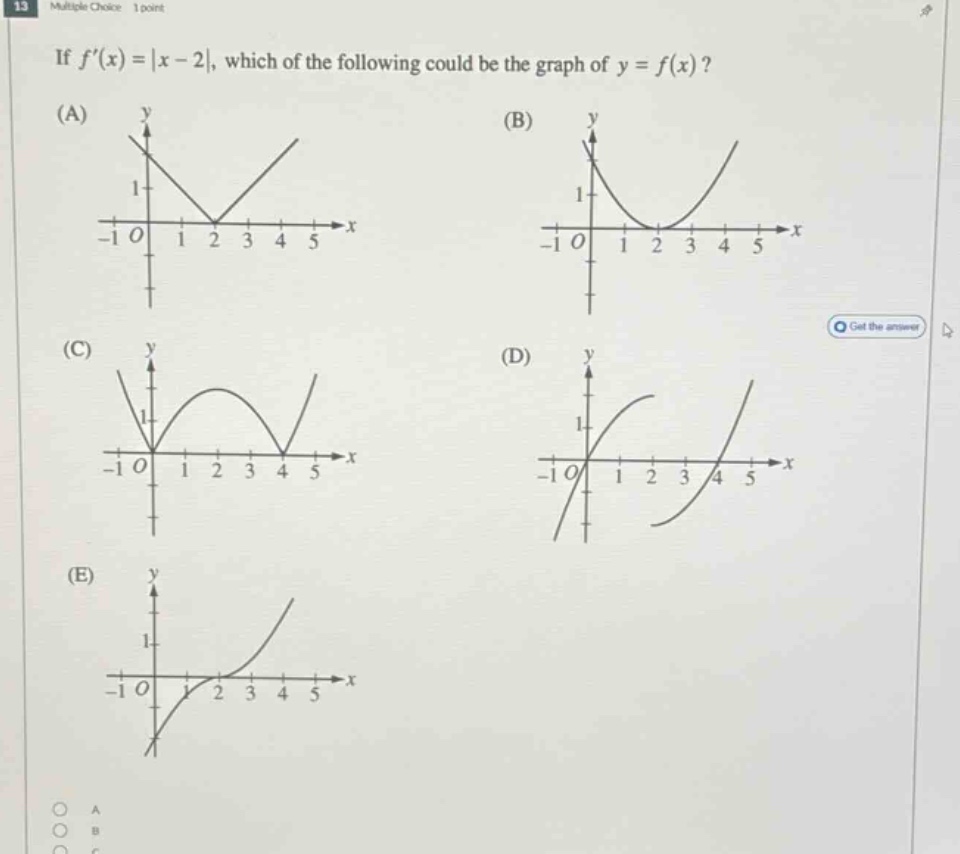
if f(x)=|x - 2|, which of the following could be the graph of y = f(x)? (a) (b) (c) (d) (e)
Answer
Answer:
B.
Explanation:
Step1: Analyze the sign of (f^{\prime}(x))
Given (f^{\prime}(x)=|x - 2|). When (x<2), (f^{\prime}(x)=2 - x), and (f^{\prime}(x)>0) for (x < 2) and (f^{\prime}(x)) is decreasing on ((-\infty,2)). When (x>2), (f^{\prime}(x)=x - 2), and (f^{\prime}(x)>0) for (x>2) and (f^{\prime}(x)) is increasing on ((2,\infty)).
Step2: Recall the relationship between (f^{\prime}(x)) and (f(x))
Since (f^{\prime}(x)\geq0) for all (x\in R), the function (y = f(x)) is non - decreasing. Also, since (f^{\prime}(x)) has a minimum at (x = 2) (because (|x - 2|\geq0) and (|x - 2| = 0) when (x=2)), the graph of (y=f(x)) has a point of inflection or a change in the concavity (in a non - strict sense for a non - differentiable (f^{\prime}(x)) at (x = 2)) at (x = 2). The function (y=f(x)) is increasing for all (x), and its rate of increase is minimum at (x = 2). Graph B shows a function that is always increasing and has a "flatter" part around (x = 2).