which of the following is the graph of $y = - 3cdotsin(\frac{1}{3}x)$?
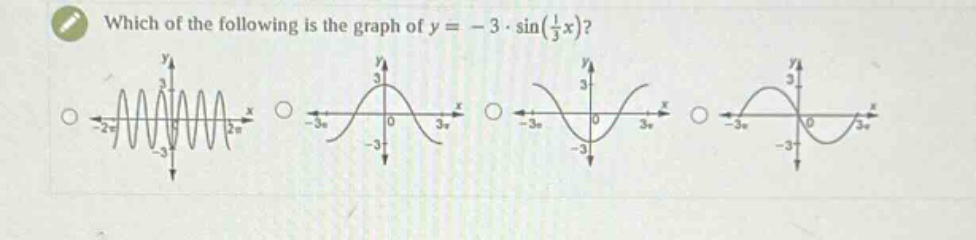
which of the following is the graph of $y = - 3cdotsin(\frac{1}{3}x)$?
Answer
Explanation:
Step1: Analyze amplitude
The general form of a sine - function is $y = A\sin(Bx)$. Here, $A=-3$, so the amplitude is $|A| = 3$, which means the graph oscillates between $y = 3$ and $y=-3$.
Step2: Analyze period
The period of the sine - function $y=\sin(Bx)$ is given by $T=\frac{2\pi}{|B|}$. For the function $y=-3\sin(\frac{1}{3}x)$, $B = \frac{1}{3}$, and the period $T=\frac{2\pi}{\frac{1}{3}}=6\pi$.
Step3: Analyze phase - shift and vertical - shift
Since the function is $y=-3\sin(\frac{1}{3}x)$ and there is no addition or subtraction inside or outside the sine function other than the coefficient, there is no phase - shift ($C = 0$) and no vertical - shift ($D = 0$). The negative sign in front of the 3 reflects the graph of $y = 3\sin(\frac{1}{3}x)$ about the $x$ - axis.
The graph that has an amplitude of 3, a period of $6\pi$, and is reflected about the $x$ - axis is the correct one.
Answer:
The graph that oscillates between $y = 3$ and $y=-3$, has a period of $6\pi$ (the distance between two consecutive peaks or troughs is $6\pi$), and is reflected about the $x$ - axis compared to a regular sine - wave. Without seeing the exact labels on the provided graphs, the correct graph should have these characteristics: start at the origin $(0,0)$ (because when $x = 0$, $y=-3\sin(0)=0$), go down first (due to the negative sign), and have a period of $6\pi$.