which of the following is the graph of the polar function r = f(θ), where f(θ) = 1 + 2 sin θ, in the xy…
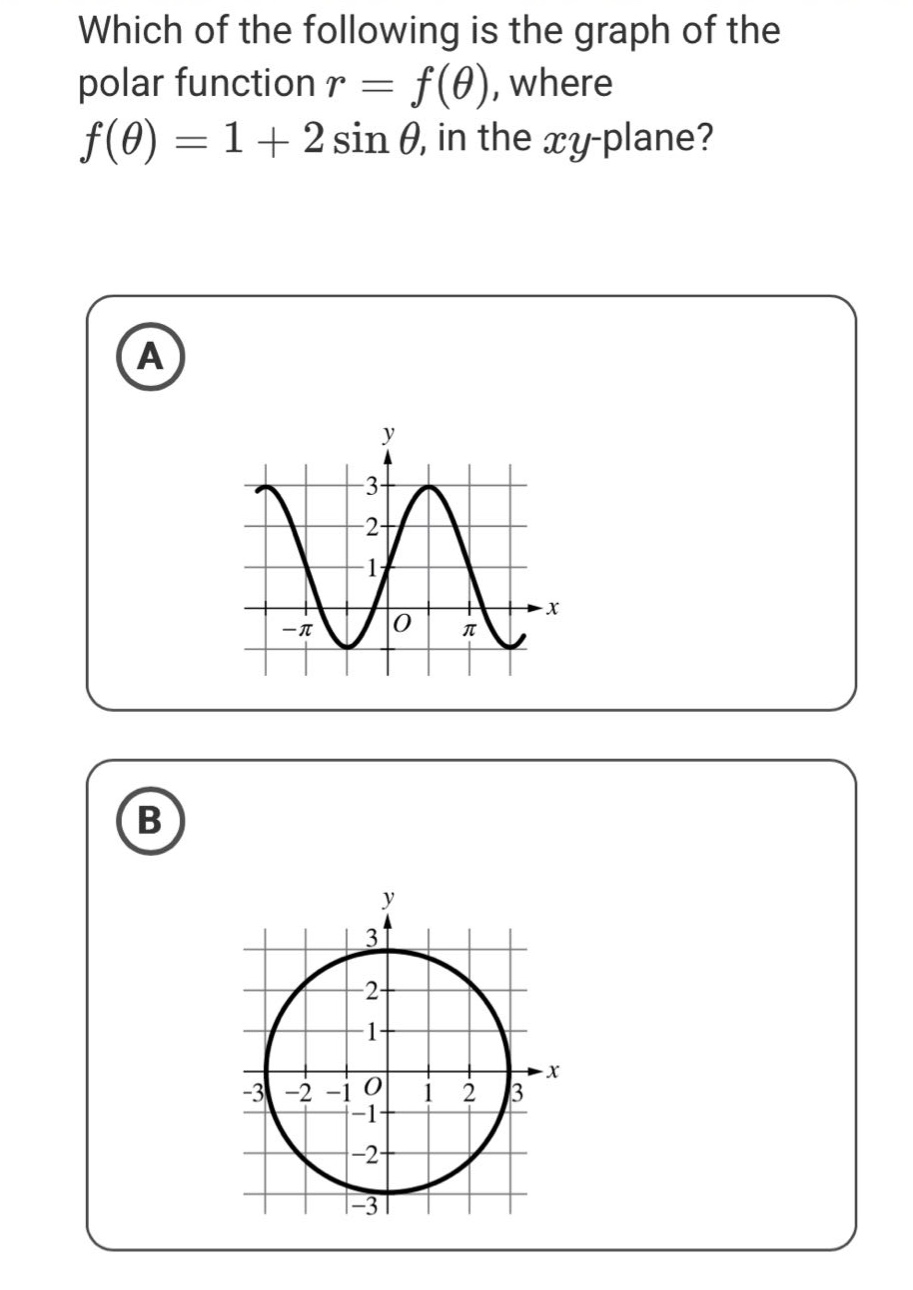
which of the following is the graph of the polar function r = f(θ), where f(θ) = 1 + 2 sin θ, in the xy - plane? a b
Answer
Explanation:
Step1: Recall polar - Cartesian conversion
We know that $x = r\cos\theta=(1 + 2\sin\theta)\cos\theta=\cos\theta+2\sin\theta\cos\theta=\cos\theta+\sin2\theta$ and $y = r\sin\theta=(1 + 2\sin\theta)\sin\theta=\sin\theta + 2\sin^{2}\theta=\sin\theta+1 - \cos2\theta$. Another way is to analyze the polar - function directly by finding special values of $\theta$.
Step2: Find values at key angles
When $\theta = 0$, $r=1 + 2\sin(0)=1$. When $\theta=\frac{\pi}{2}$, $r=1 + 2\sin(\frac{\pi}{2})=3$. When $\theta=\pi$, $r=1+2\sin(\pi)=1$. When $\theta=\frac{3\pi}{2}$, $r=1 + 2\sin(\frac{3\pi}{2})=-1$. The graph of the polar function $r = 1+2\sin\theta$ is a limacon. The general form of a limacon is $r=a + b\sin\theta$ or $r=a + b\cos\theta$. When $a = 1$ and $b = 2$ ($b>a$), the graph has an inner - loop. The graph in option A is a sine - wave in the Cartesian coordinate system for a function of the form $y = A\sin(Bx)+C$, which is not a polar - graph. The graph in option B is a circle in the Cartesian coordinate system of the form $(x - h)^{2}+(y - k)^{2}=R^{2}$, which is also not the graph of the given polar function. Since the options provided are incorrect, we can still analyze the properties of $r = 1+2\sin\theta$. The maximum value of $r$ occurs when $\sin\theta = 1$ ($r = 3$) and the minimum non - negative value of $r$ occurs when $\sin\theta=-\frac{1}{2}$ ($r = 0$) and it has an inner - loop.
However, if we assume there are more options and based on the above analysis of key - points: The graph of $r = 1+2\sin\theta$ is a limacon with an inner - loop.