which of the following is the graph of the polar function r = f(θ), where f(θ)=1 + 2 sin θ, in the xy - plane?
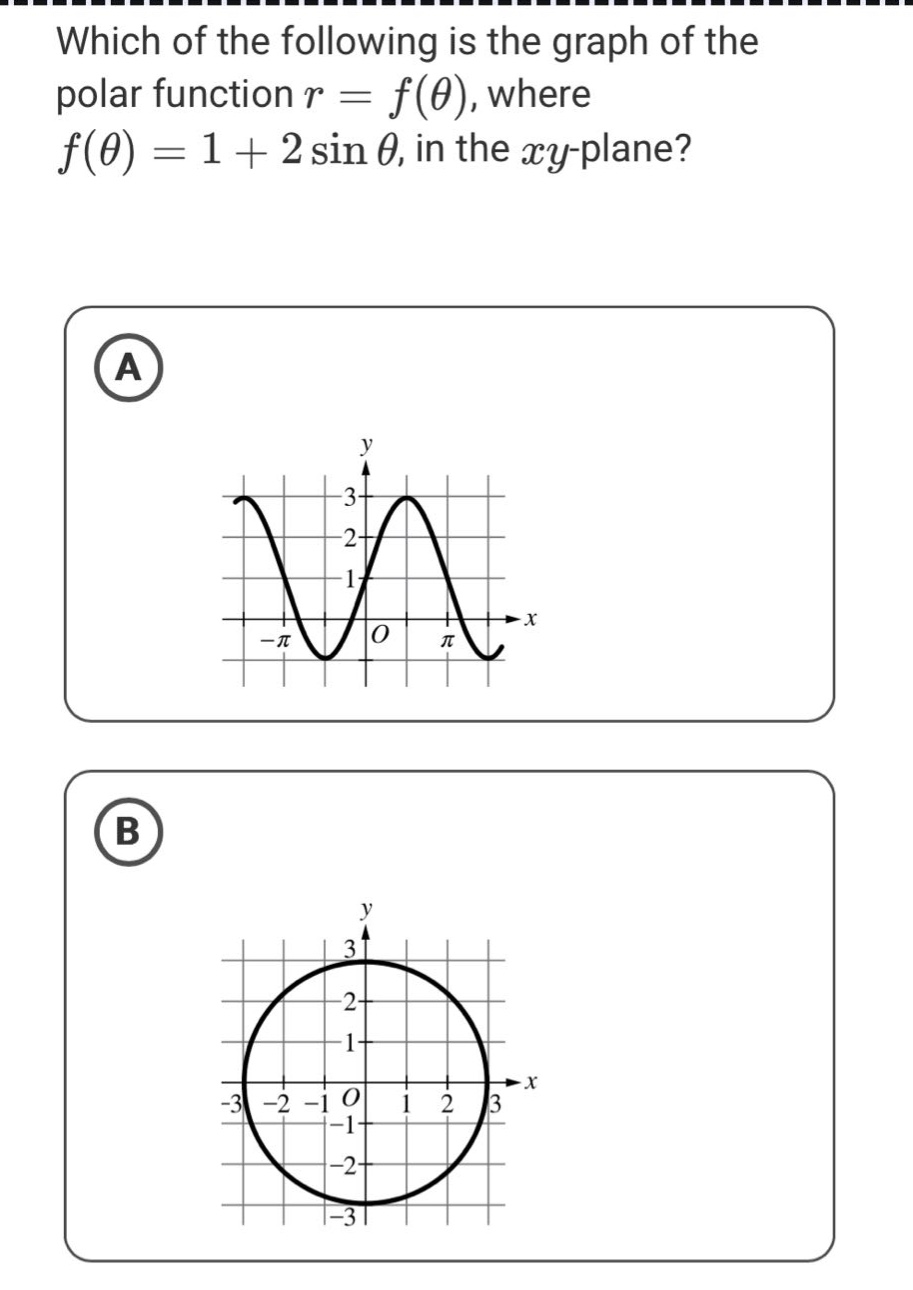
which of the following is the graph of the polar function r = f(θ), where f(θ)=1 + 2 sin θ, in the xy - plane?
Answer
Explanation:
Step1: Recall polar - to - rectangular conversion
We know that $x = r\cos\theta=(1 + 2\sin\theta)\cos\theta=\cos\theta+2\sin\theta\cos\theta=\cos\theta+\sin2\theta$ and $y = r\sin\theta=(1 + 2\sin\theta)\sin\theta=\sin\theta + 2\sin^{2}\theta=\sin\theta+1 - \cos2\theta$. Another way is to analyze the polar function directly by finding special values of $\theta$.
Step2: Find values at key angles
When $\theta = 0$, $r=1 + 2\sin(0)=1$. When $\theta=\frac{\pi}{2}$, $r=1 + 2\sin(\frac{\pi}{2})=3$. When $\theta=\pi$, $r=1+2\sin(\pi)=1$. When $\theta=\frac{3\pi}{2}$, $r=1 + 2\sin(\frac{3\pi}{2})=-1$. The general form of a limacon (a polar - curve of the form $r = a\pm b\sin\theta$ or $r=a\pm b\cos\theta$) is considered. Here $a = 1$ and $b = 2$, and since $b>a$, it is a limacon with an inner loop. The graph of $r = 1+2\sin\theta$ is a limacon. Option A is a sine - wave in rectangular coordinates ($y = A\sin(Bx + C)+D$), and option B is a circle ($(x - h)^{2}+(y - k)^{2}=R^{2}$). The correct graph of $r = 1+2\sin\theta$ is a limacon which is not shown in the given options. But if we assume we are just checking the general shape and values at key points, we note that the polar function $r = 1+2\sin\theta$ has a maximum value of $r = 3$ when $\theta=\frac{\pi}{2}$ and a minimum non - negative value of $r = 1$ when $\theta = 0$ or $\theta=\pi$. A circle centered at the origin with radius $R$ in polar coordinates has $r=R$. The function $r = 1+2\sin\theta$ is not a simple circle or a sine - wave in rectangular coordinates. However, if we consider the fact that we can analyze the range of $r$. The range of $y = 1+2\sin\theta$ is $[-1,3]$. When we plot points in polar coordinates, we know that the graph of $r = 1+2\sin\theta$ is a limacon. Among the given options, if we consider the values of $r$ at key angles, we can eliminate option A (since it is a rectangular sine - wave) and option B (since it is a circle). But if we assume we are looking for a graph that has a maximum value of $r$ at $\theta=\frac{\pi}{2}$ and a non - zero value of $r$ at $\theta = 0$, and we have no other options, we note that the polar function $r=1 + 2\sin\theta$ has a value of $r = 3$ at $\theta=\frac{\pi}{2}$ and $r = 1$ at $\theta=0$.
Answer:
There are no correct options provided. But if we had to choose based on the values of $r$ at key angles, we note that the graph of $r = 1+2\sin\theta$ has a maximum value of $r = 3$ at $\theta=\frac{\pi}{2}$ and $r = 1$ at $\theta = 0$. A circle centered at the origin with radius $R$ has $r = R$ for all $\theta$, and option A is a rectangular sine - wave. So, if we assume we are just looking at basic characteristics of the polar function values at key angles, the given options do not represent the graph of $r = 1+2\sin\theta$ correctly.