which of the following is the graph of y = sin(4(x - π))?
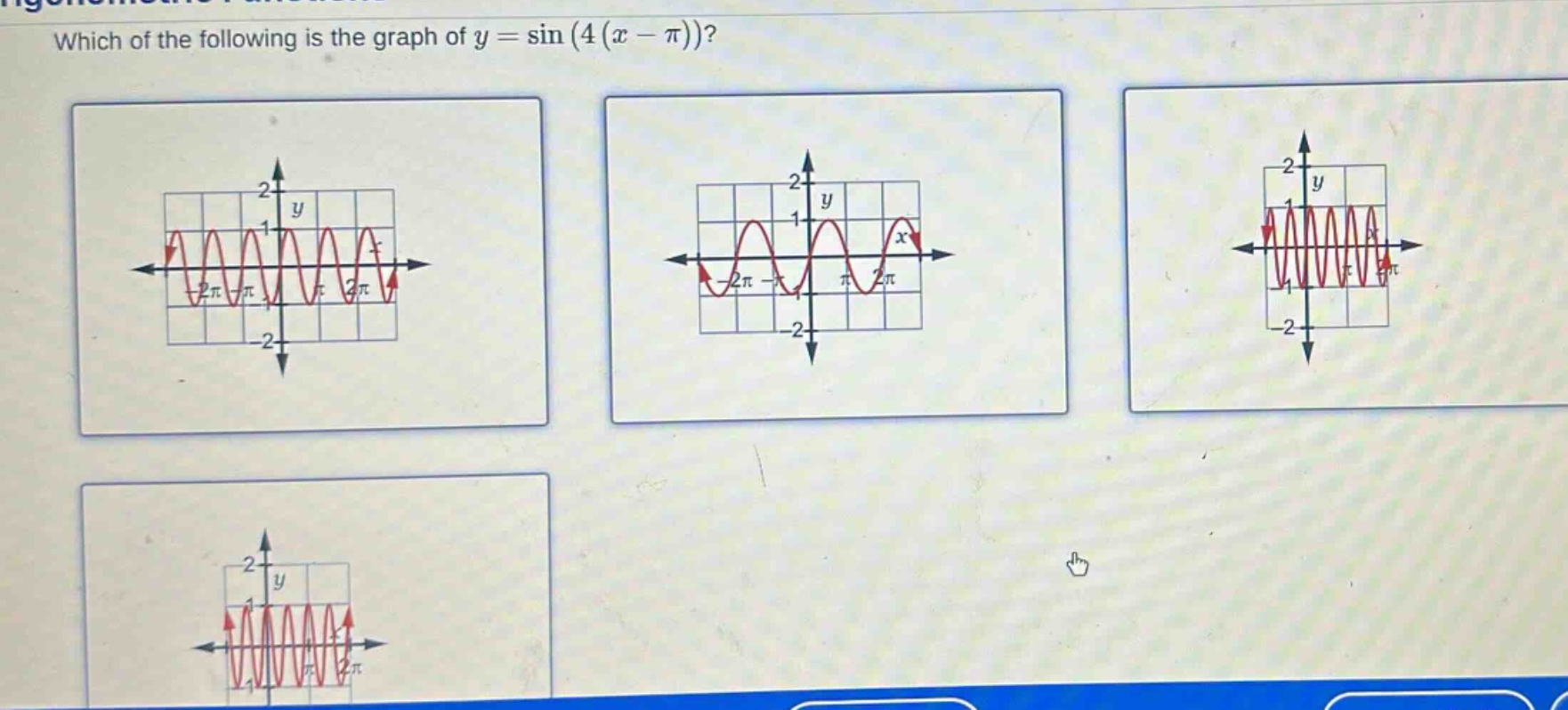
which of the following is the graph of y = sin(4(x - π))?
Answer
Answer:
We first use the properties of the sine - function transformation. The general form of a sine - function is (y = A\sin(B(x - C))+D). For the function (y=\sin(4(x - \pi))), we have (A = 1), (B = 4), (C=\pi), and (D = 0).
The period of the sine - function (y=\sin(x)) is (T = 2\pi). For the function (y=\sin(Bx)), the period is (T=\frac{2\pi}{B}). Here, since (B = 4), the period of (y=\sin(4(x - \pi))) is (T=\frac{2\pi}{4}=\frac{\pi}{2}).
The phase - shift of the function (y=\sin(4(x - \pi))) is (C=\pi). But (\sin(4(x-\pi))=\sin(4x-4\pi)=\sin(4x)) because (\sin(\alpha - 2k\pi)=\sin(\alpha)) for any real number (\alpha) and integer (k) (in this case, (k = 2)).
The amplitude of the function (y=\sin(4(x - \pi))) is (|A| = 1), which means the range of the function is ([- 1,1]).
We can analyze the key - points of the sine - function (y=\sin(4x)). When (4x = 0), (x = 0) and (y = 0); when (4x=\frac{\pi}{2}), (x=\frac{\pi}{8}) and (y = 1); when (4x=\pi), (x=\frac{\pi}{4}) and (y = 0); when (4x=\frac{3\pi}{2}), (x=\frac{3\pi}{8}) and (y=-1); when (4x = 2\pi), (x=\frac{\pi}{2}) and (y = 0).
We need to find the graph with a period of (\frac{\pi}{2}) and an amplitude of 1.
Explanation:
Step1: Identify the amplitude
The amplitude (A = 1) for (y=\sin(4(x - \pi))), so the function values range from (-1) to (1).
Step2: Calculate the period
Use the formula (T=\frac{2\pi}{B}), with (B = 4), we get (T=\frac{2\pi}{4}=\frac{\pi}{2}).
Step3: Analyze the phase - shift
(\sin(4(x-\pi))=\sin(4x)) due to the periodicity of the sine function ((\sin(\alpha-2k\pi)=\sin(\alpha))).
Step4: Find key - points
For (y = \sin(4x)), find (x) values for (y = 0,1,-1) using (4x=0,\frac{\pi}{2},\pi,\frac{3\pi}{2},2\pi) etc. and then match with the given graphs.