which of the following is the graph of $y = \\sin(4(x - \\pi))$?
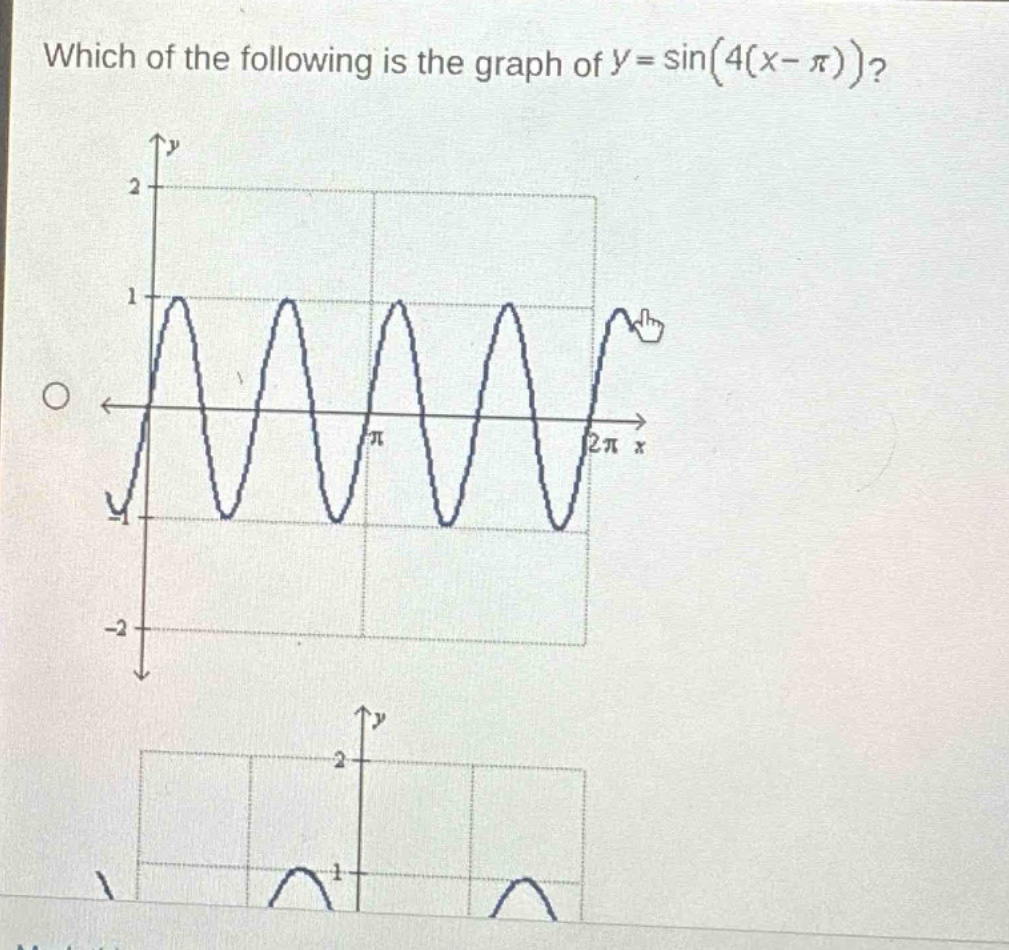
which of the following is the graph of $y = \\sin(4(x - \\pi))$?
Answer
Explanation:
Step1: Use the phase - shift and period formula
The general form of a sine function is $y = A\sin(B(x - C))+D$. For the function $y=\sin(4(x - \pi))$, we have $A = 1$, $B = 4$, $C=\pi$, $D = 0$. The period of the sine function $y=\sin(B(x - C))$ is given by $T=\frac{2\pi}{B}$. Substituting $B = 4$ into the formula, we get $T=\frac{2\pi}{4}=\frac{\pi}{2}$.
Step2: Analyze the phase - shift
The phase - shift of the function is $C=\pi$. But since $\sin(4(x-\pi))=\sin(4x - 4\pi)=\sin(4x)$ (because $\sin(\alpha+2k\pi)=\sin\alpha,k\in\mathbb{Z}$, here $\alpha = 4x$ and $k=- 2$), the graph of $y = \sin(4(x - \pi))$ is the same as the graph of $y=\sin(4x)$.
Step3: Check the key - points
For $y=\sin(4x)$, when $x = 0$, $y=\sin(0)=0$; when $x=\frac{\pi}{8}$, $y=\sin(\frac{\pi}{2}) = 1$; when $x=\frac{\pi}{4}$, $y=\sin(\pi)=0$; when $x=\frac{3\pi}{8}$, $y=\sin(\frac{3\pi}{2})=-1$; when $x=\frac{\pi}{2}$, $y=\sin(2\pi)=0$. The period is $\frac{\pi}{2}$, and the amplitude is $1$. The first graph with a period of $\frac{\pi}{2}$ and amplitude of $1$ is the correct graph.