the following is the graph of:\na. $y = \\tan\\left(2\\left(x+\frac{\\pi}{3}\\right)\\right)$\nb. $y =…
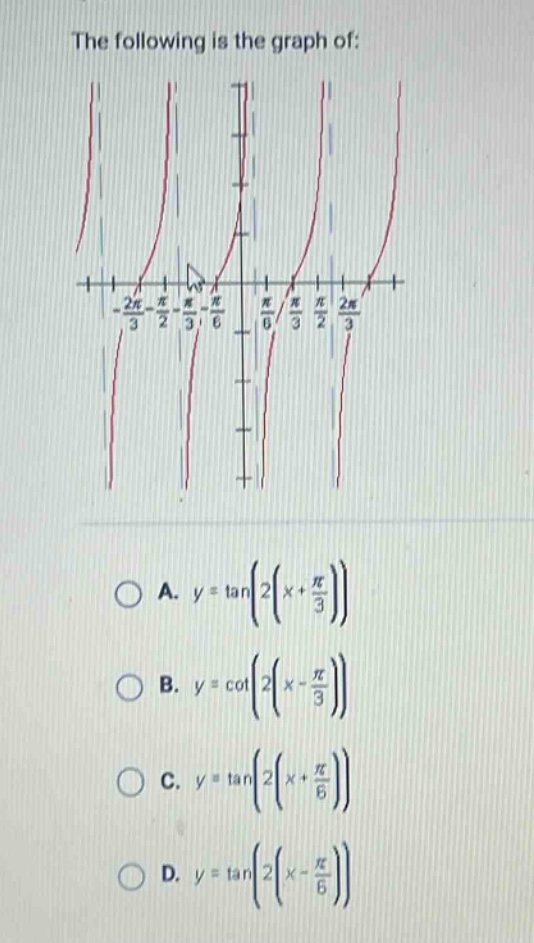
the following is the graph of:\na. $y = \\tan\\left(2\\left(x+\frac{\\pi}{3}\\right)\\right)$\nb. $y = \\cot\\left(2\\left(x - \frac{\\pi}{3}\\right)\\right)$\nc. $y = \\tan\\left(2\\left(x+\frac{\\pi}{6}\\right)\\right)$\nd. $y = \\tan\\left(2\\left(x - \frac{\\pi}{6}\\right)\\right)$
Answer
Explanation:
Step1: Recall properties of tangent function
The general form of the tangent function is $y = A\tan(B(x - C))+D$, where the period is $\frac{\pi}{|B|}$ and the phase - shift is $C$. The vertical asymptotes of $y=\tan x$ are at $x=(n+\frac{1}{2})\pi,n\in\mathbb{Z}$. For $y = \tan(B(x - C))$, the vertical asymptotes are at $B(x - C)=(n+\frac{1}{2})\pi$.
Step2: Analyze the period
The period of the given graph is $\frac{\pi}{2}$. Since the period of $y = \tan(B(x - C))$ is $\frac{\pi}{|B|}$, and $\frac{\pi}{|B|}=\frac{\pi}{2}$, we get $|B| = 2$.
Step3: Analyze the phase - shift
The vertical asymptote of the basic tangent function $y=\tan x$ is at $x = \frac{\pi}{2}+n\pi$. For the given graph, one of the vertical asymptotes is at $x=-\frac{\pi}{3}$. For the function $y=\tan(B(x - C))$ with $B = 2$, the vertical asymptote is at $2(x - C)=(n+\frac{1}{2})\pi$. When $n = - 1$, $2(x - C)=-\frac{\pi}{2}$. If we substitute $x=-\frac{\pi}{3}$ into $2(x - C)=-\frac{\pi}{2}$, we have $2(-\frac{\pi}{3}-C)=-\frac{\pi}{2}$. Solving for $C$: [ \begin{align*} -\frac{2\pi}{3}-2C&=-\frac{\pi}{2}\ -2C&=-\frac{\pi}{2}+\frac{2\pi}{3}\ -2C&=\frac{-3\pi + 4\pi}{6}\ -2C&=\frac{\pi}{6}\ C&=-\frac{\pi}{12} \end{align*} ] Another way is to use the fact that the graph of $y = \tan x$ is shifted such that we can compare with the standard form. The function $y=\tan(2(x+\frac{\pi}{6}))$ has a phase - shift of $-\frac{\pi}{6}$ and period $\frac{\pi}{2}$. The vertical asymptotes of $y=\tan(2(x+\frac{\pi}{6}))$ are given by $2(x+\frac{\pi}{6})=(n + \frac{1}{2})\pi$. Solving for $x$: [ \begin{align*} 2x+\frac{\pi}{3}&=(n+\frac{1}{2})\pi\ 2x&=(n+\frac{1}{2})\pi-\frac{\pi}{3}\ 2x&=n\pi+\frac{\pi}{2}-\frac{\pi}{3}\ 2x&=n\pi+\frac{3\pi - 2\pi}{6}\ 2x&=n\pi+\frac{\pi}{6}\ x&=\frac{n\pi}{2}+\frac{\pi}{12} \end{align*} ] When $n=-1$, $x =-\frac{\pi}{2}+\frac{\pi}{12}=-\frac{5\pi}{12}$; when $n = - \frac{1}{2}$, $x=-\frac{\pi}{4}+\frac{\pi}{12}=-\frac{\pi}{6}$. The graph of $y = \tan(2(x+\frac{\pi}{6}))$ has the correct shape, period and vertical - asymptote locations.
Answer:
C. $y=\tan\left(2\left(x+\frac{\pi}{6}\right)\right)$