which of the following is an interval with an increasing rate of change for the function g(x)=tan(x/6)…
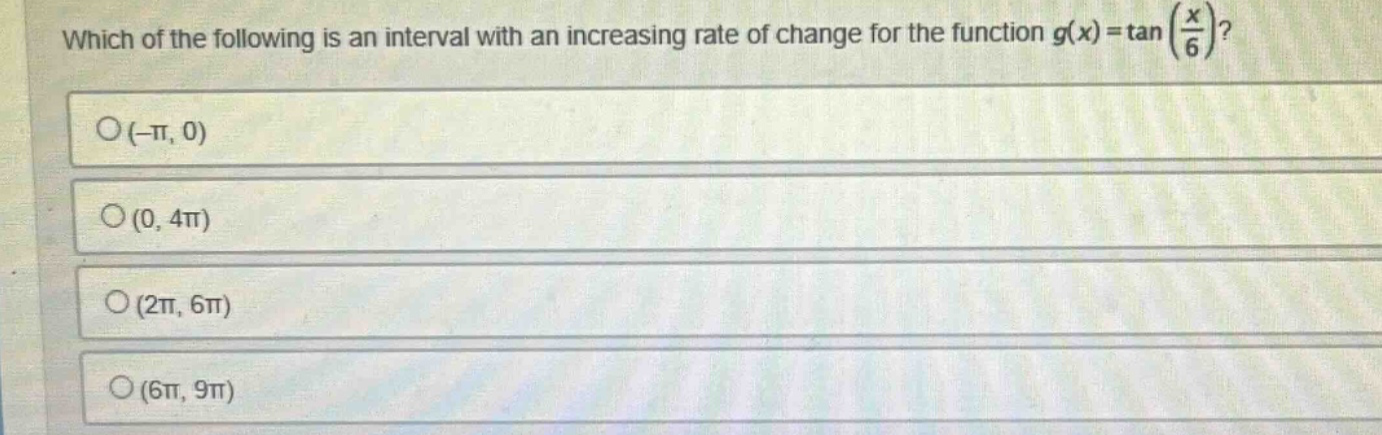
which of the following is an interval with an increasing rate of change for the function g(x)=tan(x/6)? o(-π, 0) o(0, 4π) o(2π, 6π) o(6π, 9π)
Answer
Answer:
B. $(0,4\pi)$
Explanation:
Step1: Recall derivative of tangent function
The derivative of $y = \tan(u)$ is $y'=\sec^{2}(u)\cdot u'$. For $g(x)=\tan(\frac{x}{6})$, let $u = \frac{x}{6}$, then $u'=\frac{1}{6}$. So $g'(x)=\frac{1}{6}\sec^{2}(\frac{x}{6})$.
Step2: Analyze the period of $\sec^{2}(\frac{x}{6})$
The period of $y = \sec^{2}(t)$ is the same as the period of $y=\sec(t)$, which is $2\pi$. For $y=\sec^{2}(\frac{x}{6})$, the period is $T = 12\pi$. The function $y = \sec^{2}(\frac{x}{6})\geq1$ for all $x$ in its domain. The function $g(x)$ is increasing when $g'(x)>0$, and since $g'(x)=\frac{1}{6}\sec^{2}(\frac{x}{6})>0$ for all $x$ in the domain of $g(x)$ (where $\cos(\frac{x}{6})\neq0$). The domain of $\tan(\frac{x}{6})$ has vertical - asymptotes at $\frac{x}{6}=(2n + 1)\frac{\pi}{2}$, or $x=(6n + 3)\pi,n\in\mathbb{Z}$.
Step3: Check each interval
- For the interval $(-\pi,0)$: It is part of an increasing part of the tangent - type function, but we want to find the best - fitting interval among the options.
- For the interval $(0,4\pi)$: This interval is entirely within a non - interrupted increasing part of the function $g(x)=\tan(\frac{x}{6})$.
- For the interval $(2\pi,6\pi)$: It contains a vertical asymptote at $x = 3\pi$ (since when $\frac{x}{6}=\frac{\pi}{2},x = 3\pi$), so the function is not continuously increasing on this interval.
- For the interval $(6\pi,9\pi)$: It contains a vertical asymptote at $x=9\pi$ (when $\frac{x}{6}=\frac{3\pi}{2}$), so the function is not continuously increasing on this interval.
So the interval with an increasing rate of change for the function $g(x)=\tan(\frac{x}{6})$ is $(0,4\pi)$.