which of the following is the midpoint riemann - sum approximation of ∫₄⁵√(x² + 1)dx using 4 subintervals of…
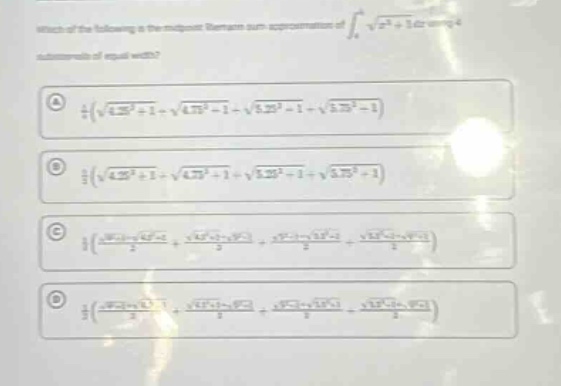
which of the following is the midpoint riemann - sum approximation of ∫₄⁵√(x² + 1)dx using 4 subintervals of equal width?\na ¼(√(4.25² + 1)+√(4.75² + 1)+√(5.25² + 1)+√(5.75² + 1))\nb ¼(√(4.25² + 1)+√(4.75² + 1)+√(5.25² + 1)+√(5.75² + 1))\nc ½((√(4² + 1)+√(4.5² + 1))/2+(√(4.5² + 1)+√(5² + 1))/2+(√(5² + 1)+√(5.5² + 1))/2+(√(5.5² + 1)+√(6² + 1))/2)\nd ½((√(4² + 1)+√(4.5² + 1))/2+(√(4.5² + 1)+√(5² + 1))/2+(√(5² + 1)+√(5.5² + 1))/2+(√(5.5² + 1)+√(6² + 1))/2)
Answer
Explanation:
Step1: Recall Riemann - sum formula
The definite integral $\int_{a}^{b}f(x)dx$ with $n$ sub - intervals of equal width $\Delta x=\frac{b - a}{n}$ and sample points $x_i=a + i\Delta x$ is approximated by the Riemann sum $\sum_{i = 1}^{n}f(x_i)\Delta x$. Here, $a = 4$, $b=5$, and $n = 4$, so $\Delta x=\frac{5 - 4}{4}=\frac{1}{4}$. The sample points $x_i$ are $x_1=4+\frac{1}{4}=4.25$, $x_2=4 + 2\times\frac{1}{4}=4.5$, $x_3=4+3\times\frac{1}{4}=4.75$, $x_4=4 + 4\times\frac{1}{4}=5$. And $f(x)=\sqrt{x^{2}+1}$.
Step2: Write out the Riemann - sum
The Riemann sum is $\sum_{i = 1}^{4}f(x_i)\Delta x=\frac{1}{4}(f(4.25)+f(4.5)+f(4.75)+f(5))=\frac{1}{4}(\sqrt{4.25^{2}+1}+\sqrt{4.5^{2}+1}+\sqrt{4.75^{2}+1}+\sqrt{5^{2}+1})$
Answer:
B. $\frac{1}{4}(\sqrt{4.25^{2}+1}+\sqrt{4.5^{2}+1}+\sqrt{4.75^{2}+1}+\sqrt{5^{2}+1})$