which of the following polynomials is guaranteed by the intermediate value theorem to have a zero on the…
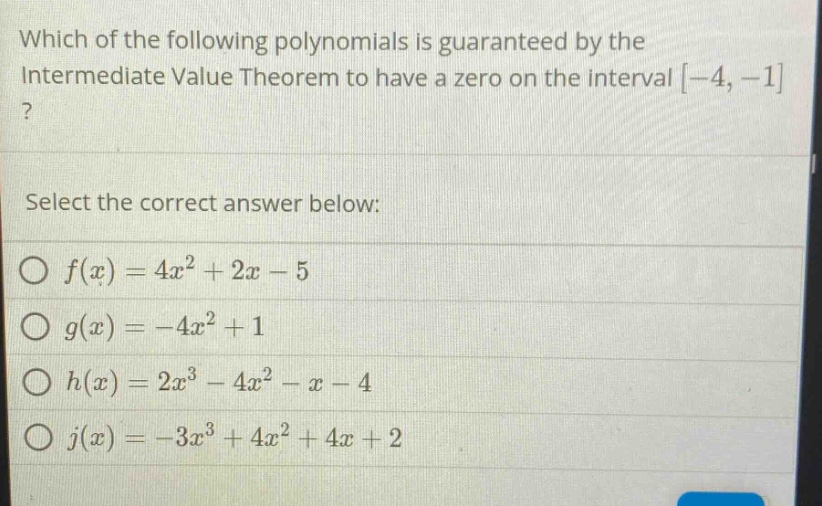
which of the following polynomials is guaranteed by the intermediate value theorem to have a zero on the interval -4, -1? select the correct answer below: o f(x)=4x² + 2x - 5 o g(x)= - 4x² + 1 o h(x)=2x³ - 4x² - x - 4 o j(x)= - 3x³ + 4x² + 4x + 2
Answer
Explanation:
Step1: Recall Intermediate Value Theorem
The Intermediate - Value Theorem states that if a function $y = f(x)$ is continuous on a closed interval $[a,b]$, and $k$ is a number between $f(a)$ and $f(b)$, then there exists at least one number $c$ in the interval $(a,b)$ such that $f(c)=k$. In the case of finding a zero, we want to check if $f(a)$ and $f(b)$ have opposite signs. Here $a=-4$ and $b = - 1$.
Step2: Evaluate $f(x)=4x^{2}+2x - 5$ at $x=-4$ and $x=-1$
When $x=-4$, $f(-4)=4\times(-4)^{2}+2\times(-4)-5=4\times16-8 - 5=64-8 - 5=51$. When $x=-1$, $f(-1)=4\times(-1)^{2}+2\times(-1)-5=4 - 2-5=-3$. Since $f(-4)=51>0$ and $f(-1)=-3<0$, by the Intermediate - Value Theorem, $f(x)$ has a zero on $[-4,-1]$.
Step3: Evaluate $g(x)=-4x^{2}+1$ at $x=-4$ and $x=-1$
When $x = - 4$, $g(-4)=-4\times(-4)^{2}+1=-4\times16 + 1=-64 + 1=-63$. When $x=-1$, $g(-1)=-4\times(-1)^{2}+1=-4 + 1=-3$. Since $g(-4)<0$ and $g(-1)<0$, there is no guarantee of a zero on $[-4,-1]$.
Step4: Evaluate $h(x)=2x^{3}-4x^{2}-x - 4$ at $x=-4$ and $x=-1$
When $x=-4$, $h(-4)=2\times(-4)^{3}-4\times(-4)^{2}-(-4)-4=2\times(-64)-4\times16 + 4-4=-128-64=-192$. When $x=-1$, $h(-1)=2\times(-1)^{3}-4\times(-1)^{2}-(-1)-4=2\times(-1)-4\times1 + 1-4=-2-4 + 1-4=-9$. Since $h(-4)<0$ and $h(-1)<0$, there is no guarantee of a zero on $[-4,-1]$.
Step5: Evaluate $j(x)=-3x^{3}+4x^{2}+4x + 2$ at $x=-4$ and $x=-1$
When $x=-4$, $j(-4)=-3\times(-4)^{3}+4\times(-4)^{2}+4\times(-4)+2=-3\times(-64)+4\times16-16 + 2=192+64-16 + 2=242$. When $x=-1$, $j(-1)=-3\times(-1)^{3}+4\times(-1)^{2}+4\times(-1)+2=-3\times(-1)+4\times1-4 + 2=3 + 4-4 + 2=5$. Since $j(-4)>0$ and $j(-1)>0$, there is no guarantee of a zero on $[-4,-1]$.
Answer:
$f(x)=4x^{2}+2x - 5$