the following sequence, defined by a recurrence relation, is monotonic and bounded, and therefore converges…
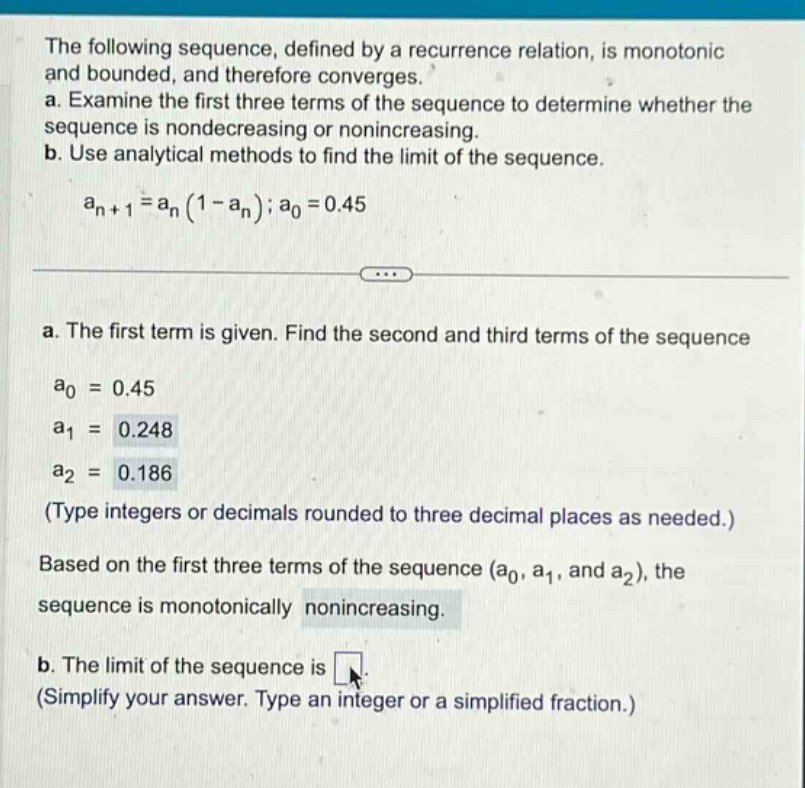
the following sequence, defined by a recurrence relation, is monotonic and bounded, and therefore converges. a. examine the first three terms of the sequence to determine whether the sequence is nondecreasing or nonincreasing. b. use analytical methods to find the limit of the sequence. a_n + 1=a_n(1 - a_n); a_0 = 0.45 a. the first term is given. find the second and third terms of the sequence a_0 = 0.45 a_1 = 0.248 a_2 = 0.186 (type integers or decimals rounded to three decimal places as needed.) based on the first three terms of the sequence (a_0, a_1, and a_2), the sequence is monotonically nonincreasing. b. the limit of the sequence is. (simplify your answer. type an integer or a simplified fraction.)
Answer
Explanation:
Step1: Let $\lim_{n\rightarrow\infty}a_n = L$.
Since $\lim_{n\rightarrow\infty}a_{n + 1}=\lim_{n\rightarrow\infty}a_n = L$ for a convergent sequence.
Step2: Take the limit of both sides of the recurrence relation.
Given $a_{n+1}=a_n(1 - a_n)$, we have $\lim_{n\rightarrow\infty}a_{n + 1}=\lim_{n\rightarrow\infty}[a_n(1 - a_n)]$. Substituting $\lim_{n\rightarrow\infty}a_{n + 1}=L$ and $\lim_{n\rightarrow\infty}a_n = L$, we get $L = L(1 - L)$.
Step3: Solve the resulting equation for $L$.
Expand the right - hand side: $L = L - L^2$. Then, move all terms to one side: $L^2=0$. So, $L = 0$.
Answer:
$0$