which of the following shows the graph of $y = 2e^{x}$?
which of the following shows the graph of $y = 2e^{x}$?
Answer
- Analyze the properties of the function (y = 2e^{x}):
- Inter - cept:
- Find the (y) - intercept. Set (x = 0). Then (y=2e^{0}). Since (e^{0}=1), we have (y = 2\times1=2). So the graph of the function (y = 2e^{x}) passes through the point ((0,2)).
- Asymptote:
- The exponential function (y = e^{x}) has a horizontal asymptote (y = 0) as (x\to-\infty). For the function (y = 2e^{x}), as (x\to-\infty), (y\to0) (because (e^{x}=\frac{1}{e^{-x}}) and as (x\to-\infty), (e^{-x}\to+\infty), so (2e^{x}\to0)). Also, as (x\to+\infty), (e^{x}\to+\infty), and (y = 2e^{x}\to+\infty). The function (y = 2e^{x}) is an exponential growth function (since the base (e\approx2.718>1)) and the coefficient (2>0).
- Inter - cept:
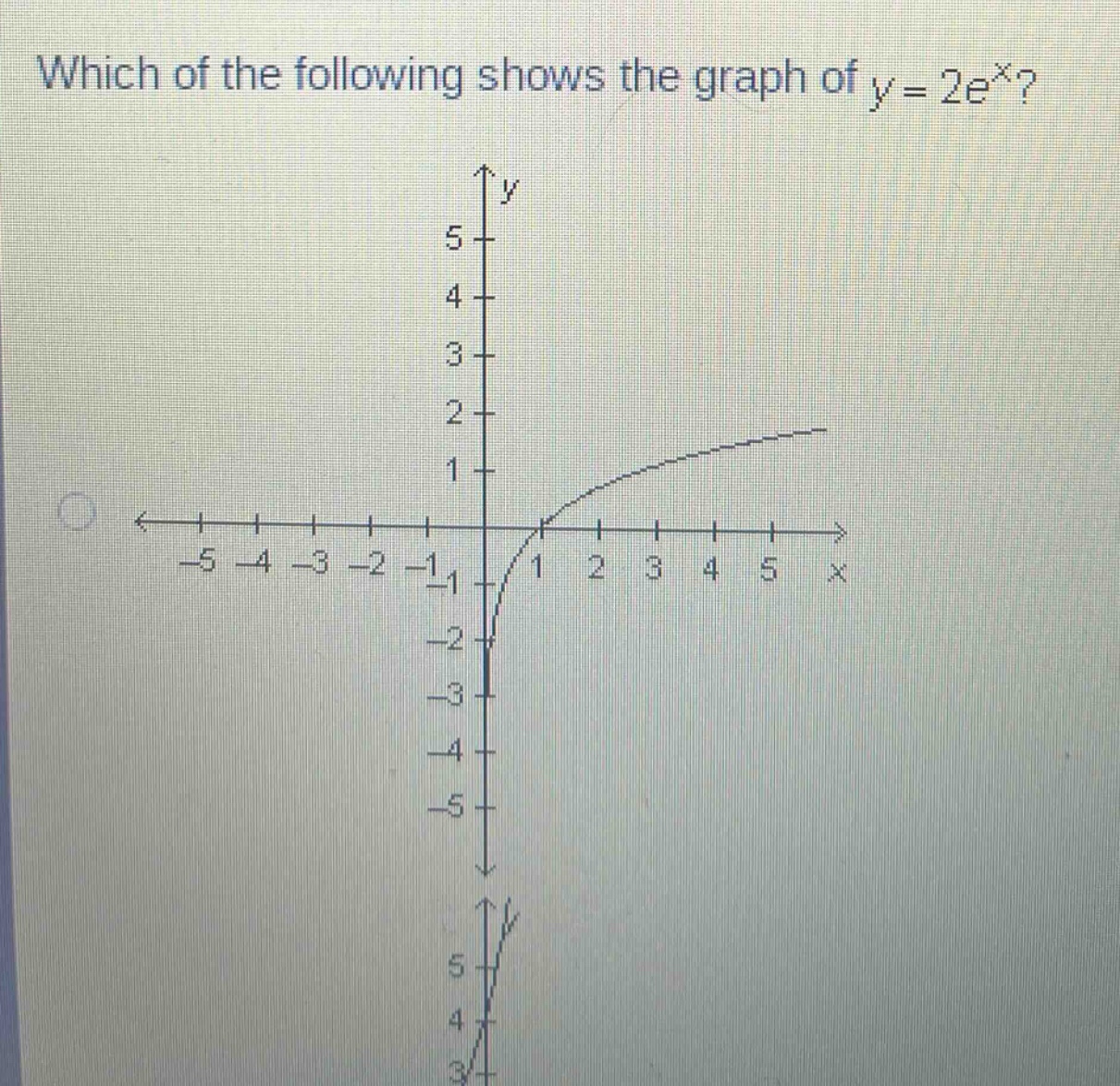
- Evaluate the given graph:
- The graph provided does not pass through the point ((0,2)) (it passes through ((0, - 2)) approximately), so it is not the graph of (y = 2e^{x}). Since no other options are given, we can't determine the correct graph from the available choices, but we know the key features of (y = 2e^{x}) as described above.
Since no correct graph is shown among the options provided, we can't give a definite answer from the given choices. But if we were to describe the correct graph:
Answer: A graph that passes through the point ((0,2)), has a horizontal asymptote (y = 0) as (x\to-\infty), and increases without bound as (x\to+\infty).
Explanation:
Step1: Find y - intercept
Set (x = 0), (y=2e^{0}=2).
Step2: Analyze asymptote
As (x\to-\infty), (y = 2e^{x}\to0); as (x\to+\infty), (y = 2e^{x}\to+\infty).