which of the following statements are true about the graph of the function (f(x)=(\frac{1}{2})^x - 7)? the…
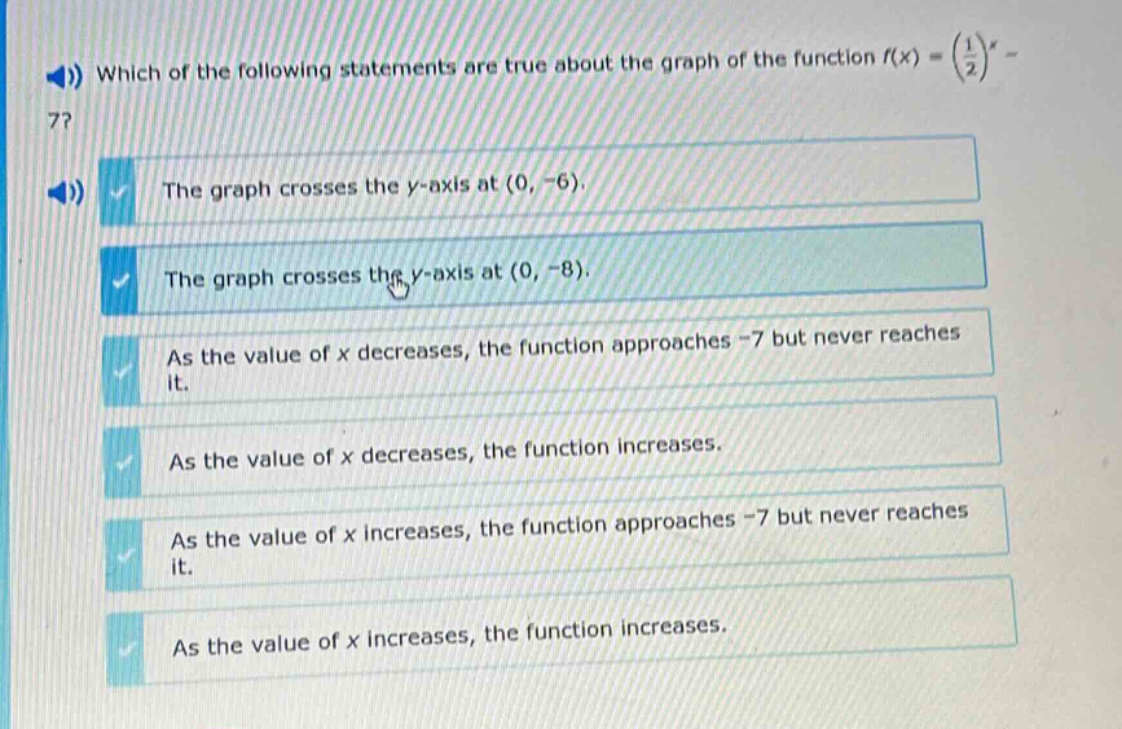
which of the following statements are true about the graph of the function (f(x)=(\frac{1}{2})^x - 7)? the graph crosses the y - axis at ((0, - 6)). the graph crosses the y - axis at ((0, - 8)). as the value of x decreases, the function approaches - 7 but never reaches it. as the value of x decreases, the function increases. as the value of x increases, the function approaches - 7 but never reaches it. as the value of x increases, the function increases.
Answer
Explanation:
Step1: Find y - intercept
Set (x = 0) in (y=f(x)=\left(\frac{1}{2}\right)^{x}-7). Then (y=\left(\frac{1}{2}\right)^{0}-7). Since any non - zero number to the power of 0 is 1, (y = 1-7=-6). So the graph crosses the (y) - axis at ((0, - 6)).
Step2: Analyze behavior as (x) decreases
The function is (y=\left(\frac{1}{2}\right)^{x}-7). As (x) decreases, (\left(\frac{1}{2}\right)^{x}) increases because (\left(\frac{1}{2}\right)^{x}=2^{-x}), and when (x) is negative, the exponent of 2 is positive and getting larger. So (y=\left(\frac{1}{2}\right)^{x}-7) increases. Also, (\lim_{x\rightarrow-\infty}\left(\frac{1}{2}\right)^{x}-7=\infty - 7=\infty).
Step3: Analyze behavior as (x) increases
As (x) increases, (\left(\frac{1}{2}\right)^{x}) approaches 0 because for an exponential function (y = a^{x}) where (0\lt a\lt1), (\lim_{x\rightarrow\infty}a^{x}=0). So (\lim_{x\rightarrow\infty}\left(\frac{1}{2}\right)^{x}-7=0 - 7=-7), and the function approaches (-7) but never reaches it.
Answer:
The graph crosses the (y) - axis at ((0, - 6)); As the value of (x) decreases, the function increases; As the value of (x) increases, the function approaches (-7) but never reaches it.