which of the following statements are true of this rational function? check all of the boxes that apply…
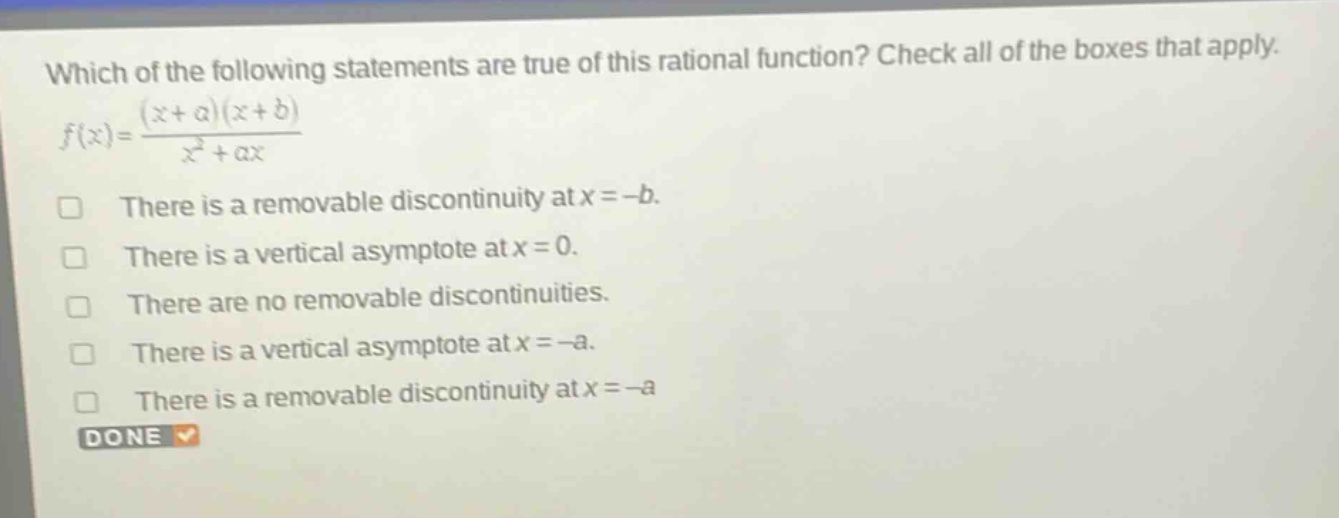
which of the following statements are true of this rational function? check all of the boxes that apply. $f(x)=\frac{(x + a)(x + b)}{x^{2}+ax}$\nthere is a removable discontinuity at $x=-b$.\nthere is a vertical asymptote at $x = 0$.\nthere are no removable discontinuities.\nthere is a vertical asymptote at $x=-a$.\nthere is a removable discontinuity at $x=-a$\ndone
Answer
Explanation:
Step1: Simplify the rational function
First, factor the denominator $x^{2}+ax=x(x + a)$. So $f(x)=\frac{(x + a)(x + b)}{x(x + a)}$. When $x\neq - a$, we can cancel out the $(x + a)$ terms and get $f(x)=\frac{x + b}{x}$ for $x\neq - a$.
Step2: Analyze removable discontinuities
A removable discontinuity occurs when a factor can be canceled out in the numerator and denominator. Since we can cancel out $(x + a)$ (when $x\neq - a$), there is a removable discontinuity at $x=-a$.
Step3: Analyze vertical asymptotes
Vertical asymptotes occur at the values of $x$ that make the denominator equal to zero after simplification. The simplified function $y = \frac{x + b}{x}$ has a denominator of $x$, so when $x = 0$, the function has a vertical asymptote.
Answer:
There is a vertical asymptote at $x = 0$. There is a removable discontinuity at $x=-a$.