which of the following is true for (f(x)= - 2sin(x)-3)?\nthe range of the function is the set of real…
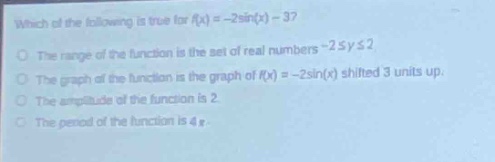
which of the following is true for (f(x)= - 2sin(x)-3)?\nthe range of the function is the set of real numbers (-2leq yleq2).\nthe graph of the function is the graph of (f(x)= - 2sin(x)) shifted 3 units up.\nthe amplitude of the function is 2.\nthe period of the function is (4pi).
Answer
Answer:
The amplitude of the function is 2.
Explanation:
Step1: Recall sine - function properties
The general form of a sine function is (y = A\sin(Bx - C)+D), where (A) is the amplitude, (B) affects the period ((T=\frac{2\pi}{|B|})), (C) is the phase - shift, and (D) is the vertical shift. For the function (f(x)=- 2\sin(x)-3), we have (A = - 2), (B = 1), (C = 0), and (D=-3).
Step2: Analyze the range
The range of (y = \sin(x)) is ([-1,1]). For (y=-2\sin(x)-3), when (\sin(x)=-1), (y=-2\times(-1)-3=-1); when (\sin(x) = 1), (y=-2\times1 - 3=-5). So the range is ([-5,-1]), not (-2\leq y\leq2).
Step3: Analyze the vertical shift
The graph of (y=-2\sin(x)-3) is the graph of (y = - 2\sin(x)) shifted 3 units down (because (D=-3)), not 3 units up.
Step4: Analyze the amplitude
The amplitude of (y = A\sin(Bx - C)+D) is (|A|). Since (A=-2), the amplitude (|A| = 2).
Step5: Analyze the period
For (y=-2\sin(x)-3), since (B = 1), the period (T=\frac{2\pi}{|B|}=\frac{2\pi}{1}=2\pi), not (4\pi).