if f(x) < 0 and f(x) < 0, then which of the following is true?\n\nf(x) is increasing and concave up\n\nf(x)…
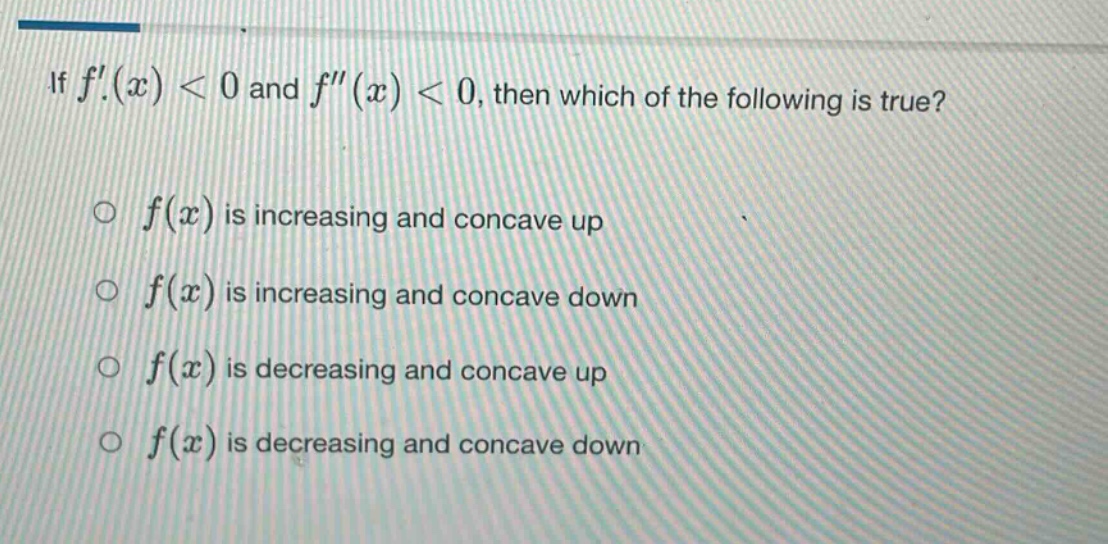
if f(x) < 0 and f(x) < 0, then which of the following is true?\n\nf(x) is increasing and concave up\n\nf(x) is increasing and concave down\n\nf(x) is decreasing and concave up\n\nf(x) is decreasing and concave down
Answer
Explanation:
Step1: Analyze the first - derivative
The first - derivative $f'(x)$ determines the increasing or decreasing nature of the function. If $f'(x)<0$ for all $x$ in an interval, then the function $y = f(x)$ is decreasing on that interval.
Step2: Analyze the second - derivative
The second - derivative $f''(x)$ determines the concavity of the function. If $f''(x)<0$ for all $x$ in an interval, then the function $y = f(x)$ is concave down on that interval.
Answer:
$f(x)$ is decreasing and concave down