which of the following are true statements? select all that apply. the cosecant graph has a local minimum…
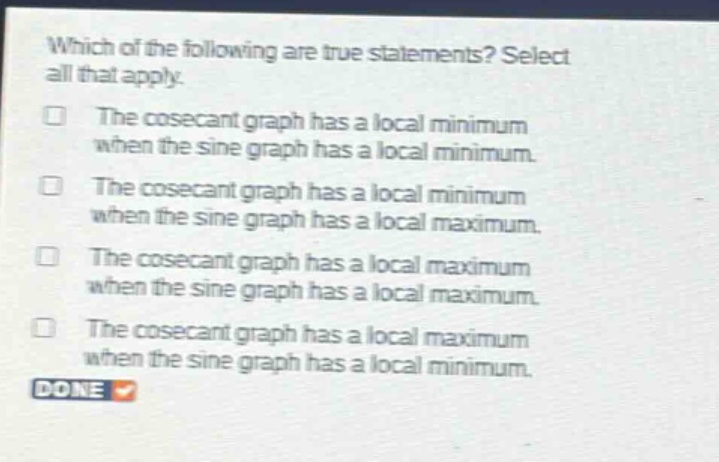
which of the following are true statements? select all that apply. the cosecant graph has a local minimum when the sine graph has a local minimum. the cosecant graph has a local minimum when the sine graph has a local maximum. the cosecant graph has a local maximum when the sine graph has a local maximum. the cosecant graph has a local maximum when the sine graph has a local minimum. done
Answer
Answer:
B. The cosecant graph has a local minimum when the sine graph has a local maximum. D. The cosecant graph has a local maximum when the sine graph has a local minimum.
Explanation:
We know that (y = \csc(x)=\frac{1}{\sin(x)}).
Let's consider the behavior of the function.
Case 1: When (\sin(x)) has a local maximum
Let (x = a) be a point where (y=\sin(x)) has a local maximum. So, (\sin(a)=M), where (M) is the maximum value of (\sin(x)) ((M = 1) since (- 1\leqslant\sin(x)\leqslant1)). Then (\csc(a)=\frac{1}{\sin(a)} = 1). For values of (x) near (a), if (x) is in a small neighborhood of (a), (\sin(x)) is less than or equal to (\sin(a)). So, (\csc(x)=\frac{1}{\sin(x)}) is greater than or equal to (\csc(a)) for (x) near (a). So, (y = \csc(x)) has a local minimum at the points where (y=\sin(x)) has a local maximum.
Case 2: When (\sin(x)) has a local minimum
Let (x = b) be a point where (y=\sin(x)) has a local minimum. So, (\sin(b)=m), where (m) is the minimum value of (\sin(x)) ((m=-1) since (-1\leqslant\sin(x)\leqslant1)). Then (\csc(b)=\frac{1}{\sin(b)}=- 1). For values of (x) near (b), if (x) is in a small neighborhood of (b), (\sin(x)) is greater than or equal to (\sin(b)). So, (\csc(x)=\frac{1}{\sin(x)}) is less than or equal to (\csc(b)) for (x) near (b). So, (y=\csc(x)) has a local maximum at the points where (y = \sin(x)) has a local minimum.