which of the following are true statements? select all that apply.\nthe cosecant graph has a local minimum…
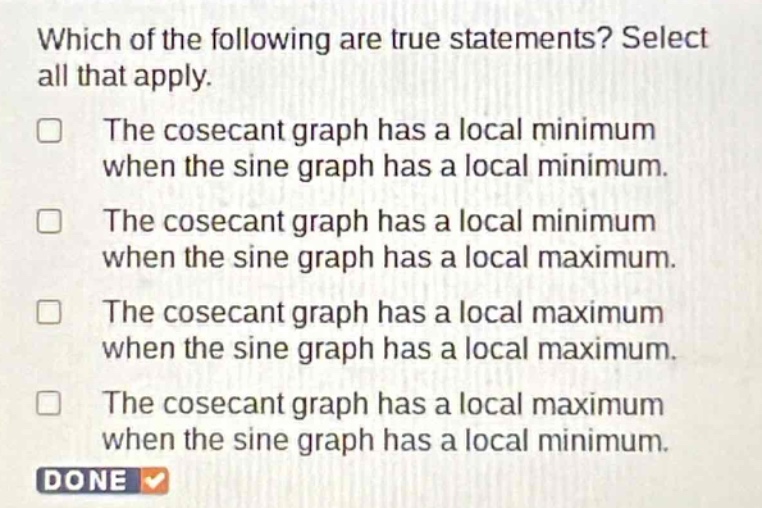
which of the following are true statements? select all that apply.\nthe cosecant graph has a local minimum when the sine graph has a local minimum.\nthe cosecant graph has a local minimum when the sine graph has a local maximum.\nthe cosecant graph has a local maximum when the sine graph has a local maximum.\nthe cosecant graph has a local maximum when the sine graph has a local minimum.
Answer
Explanation:
Step1: Recall the relationship between sine and cosecant
The cosecant function is defined as $y = \csc(x)=\frac{1}{\sin(x)}$.
Step2: Analyze local - extrema relationship
When $\sin(x)$ has a local maximum, say $\sin(x)=1$ (for example, at $x = \frac{\pi}{2}+ 2k\pi,k\in\mathbb{Z}$), then $\csc(x)=\frac{1}{\sin(x)} = 1$ which is a local minimum for $\csc(x)$ since for values of $x$ near $\frac{\pi}{2}+2k\pi$, $\sin(x)$ is less than 1 and $\csc(x)=\frac{1}{\sin(x)}$ is greater than 1. When $\sin(x)$ has a local minimum, say $\sin(x)= - 1$ (for example, at $x=\frac{3\pi}{2}+2k\pi,k\in\mathbb{Z}$), then $\csc(x)=\frac{1}{\sin(x)}=-1$ which is a local maximum for $\csc(x)$ since for values of $x$ near $\frac{3\pi}{2}+2k\pi$, $\sin(x)$ is greater than - 1 and $\csc(x)=\frac{1}{\sin(x)}$ is less than - 1.
Answer:
The cosecant graph has a local minimum when the sine graph has a local maximum. The cosecant graph has a local maximum when the sine graph has a local minimum.