in the following, use that we know 1 / (1 - x) = sum(n = 0 to infinity) x^n, for |x| < 1. for the following…
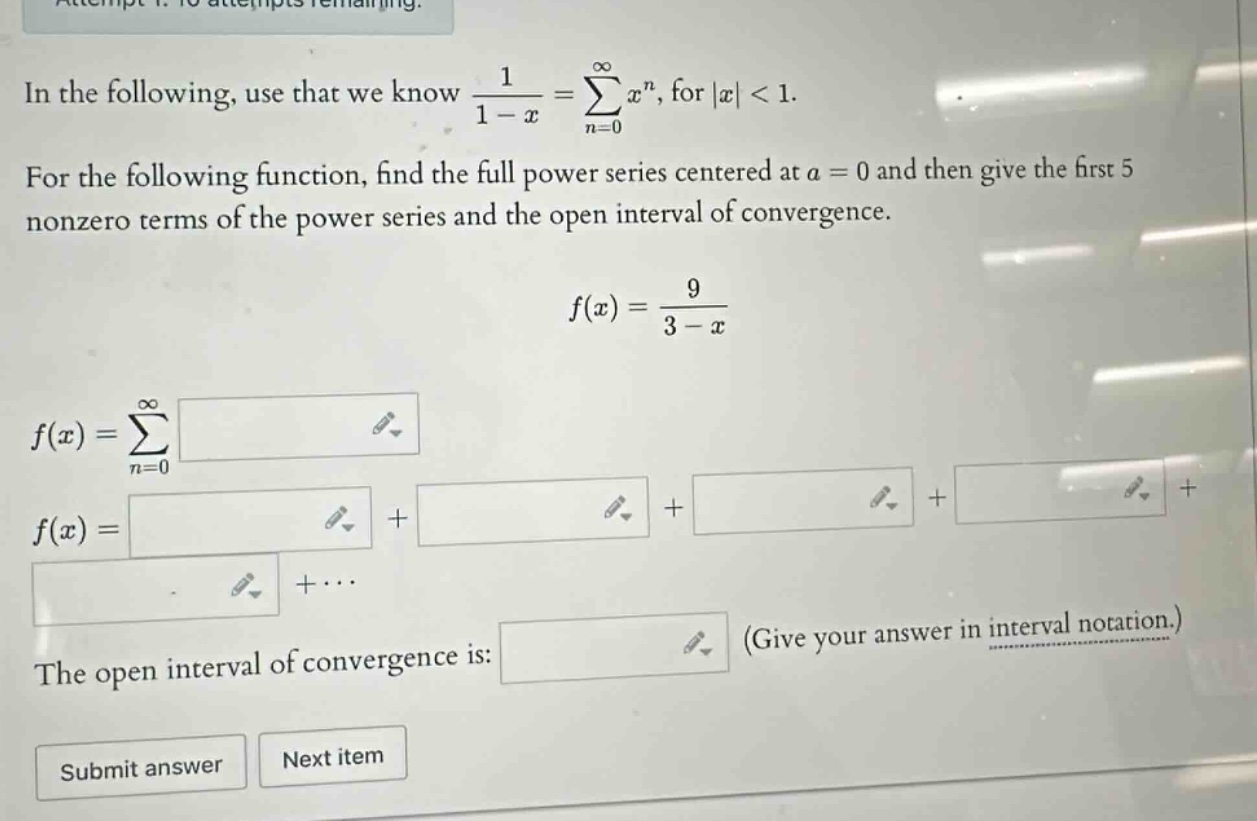
in the following, use that we know 1 / (1 - x) = sum(n = 0 to infinity) x^n, for |x| < 1. for the following function, find the full power series centered at a = 0 and then give the first 5 nonzero terms of the power series and the open interval of convergence. f(x) = 9 / (3 - x) f(x) = sum(n = 0 to infinity) f(x) = + + + + +... the open interval of convergence is: (give your answer in interval notation.) submit answer next item
Answer
Explanation:
Step1: Rewrite the function
Rewrite $f(x)=\frac{9}{3 - x}$ as $f(x)=\frac{3}{1-\frac{x}{3}}$.
Step2: Use the geometric - series formula
Since $\frac{1}{1 - t}=\sum_{n = 0}^{\infty}t^{n}$ for $|t|<1$, let $t=\frac{x}{3}$. Then $f(x)=3\sum_{n = 0}^{\infty}(\frac{x}{3})^{n}=\sum_{n = 0}^{\infty}\frac{3}{3^{n}}x^{n}=\sum_{n = 0}^{\infty}\frac{1}{3^{n - 1}}x^{n}$.
Step3: Find the first 5 non - zero terms
When $n = 0$, the term is $\frac{1}{3^{-1}}x^{0}=3$. When $n = 1$, the term is $\frac{1}{3^{0}}x^{1}=x$. When $n = 2$, the term is $\frac{1}{3^{1}}x^{2}=\frac{1}{3}x^{2}$. When $n = 3$, the term is $\frac{1}{3^{2}}x^{3}=\frac{1}{9}x^{3}$. When $n = 4$, the term is $\frac{1}{3^{3}}x^{4}=\frac{1}{27}x^{4}$.
Step4: Find the interval of convergence
Since $|t|<1$ and $t = \frac{x}{3}$, we have $|\frac{x}{3}|<1$. Solving for $x$ gives $|x|<3$. So the open interval of convergence is $(-3,3)$.
Answer:
$f(x)=\sum_{n = 0}^{\infty}\frac{1}{3^{n - 1}}x^{n}$; $f(x)=3 + x+\frac{1}{3}x^{2}+\frac{1}{9}x^{3}+\frac{1}{27}x^{4}+\cdots$; $(-3,3)$