f(x)=\frac{-2x^{2}+14}{x^{2}-49}\nwhich statement describes the behavior of the graph of the function shown…
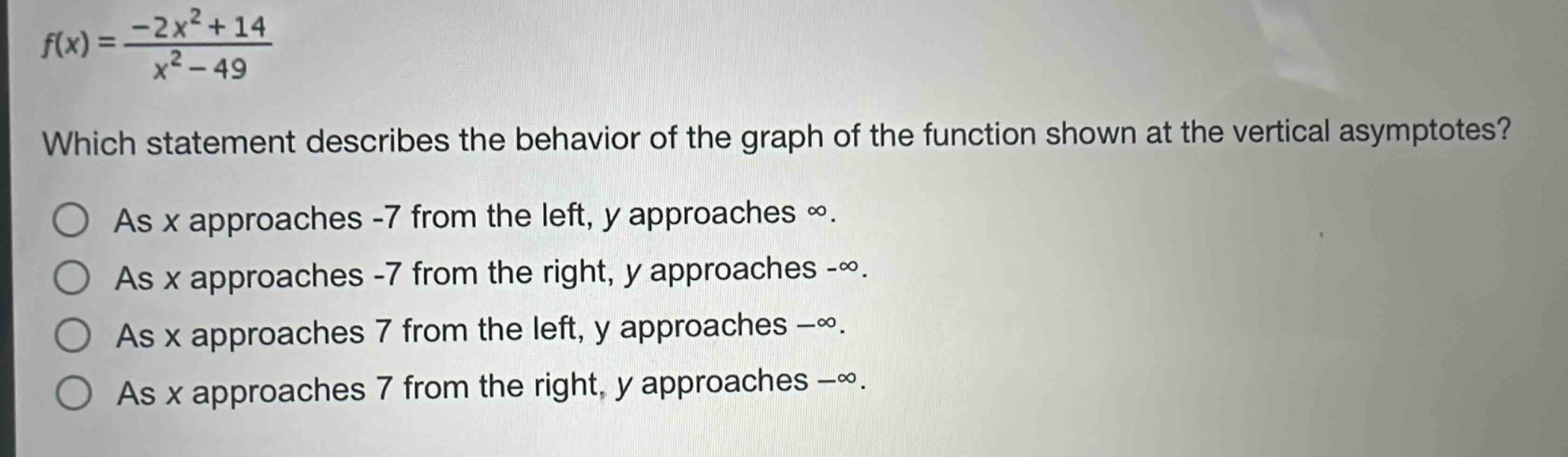
f(x)=\frac{-2x^{2}+14}{x^{2}-49}\nwhich statement describes the behavior of the graph of the function shown at the vertical asymptotes?\nas x approaches -7 from the left, y approaches ∞.\nas x approaches -7 from the right, y approaches -∞.\nas x approaches 7 from the left, y approaches -∞.\nas x approaches 7 from the right, y approaches -∞.
Answer
Answer:
As (x) approaches (7) from the left, (y) approaches (-\infty).
Explanation:
Step1: Find vertical asymptotes
Set denominator (x^{2}-49 = 0), so ((x + 7)(x - 7)=0), then (x=-7) and (x = 7) are vertical - asymptotes.
Step2: Analyze (x=-7) behavior
For (x\to - 7^{-}), (f(x)=\frac{-2x^{2}+14}{(x + 7)(x - 7)}), numerator (-2x^{2}+14\lt0), denominator ((x + 7)(x - 7)\to0^{+}), so (y\to-\infty). For (x\to - 7^{+}), numerator (-2x^{2}+14\lt0), denominator ((x + 7)(x - 7)\to0^{-}), so (y\to\infty).
Step3: Analyze (x = 7) behavior
For (x\to7^{-}), numerator (-2x^{2}+14\lt0), denominator ((x + 7)(x - 7)\to0^{-}), so (y\to-\infty). For (x\to7^{+}), numerator (-2x^{2}+14\lt0), denominator ((x + 7)(x - 7)\to0^{+}), so (y\to-\infty).