f(x)=\frac{x^{2}+4}{4x^{2}-4x - 8}\nname the horizontal asymptote(s).\ny = 1/4\ncomplete\nbecause\nm < n\nm…
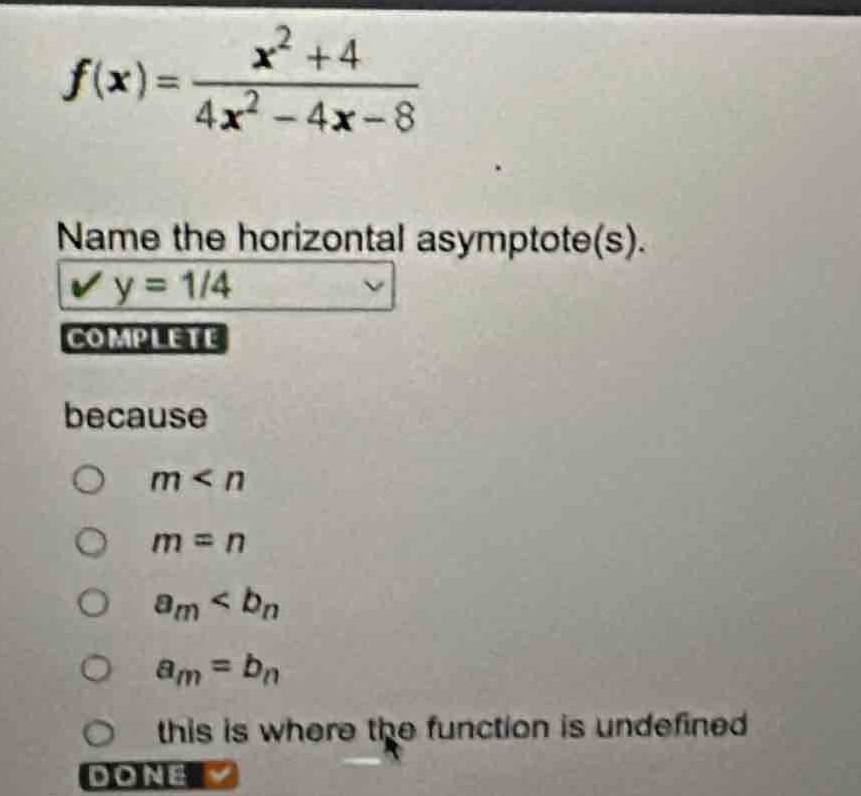
f(x)=\frac{x^{2}+4}{4x^{2}-4x - 8}\nname the horizontal asymptote(s).\ny = 1/4\ncomplete\nbecause\nm < n\nm = n\n a_m < b_n\n a_m = b_n\nthis is where the function is undefined\ndone
Answer
Explanation:
Step1: Identify degrees of polynomials
For a rational function $f(x)=\frac{a(x)}{b(x)}=\frac{x^{2}+4}{4x^{2}-4x - 8}$, the degree $m$ of the numerator $a(x)=x^{2}+4$ is $m = 2$ (highest - power of $x$ is 2), and the degree $n$ of the denominator $b(x)=4x^{2}-4x - 8$ is $n = 2$.
Step2: Recall horizontal - asymptote rule
When $m = n$ (the degrees of the numerator and denominator are equal) for a rational function $y=\frac{a(x)}{b(x)}=\frac{a_mx^m+\cdots+a_0}{b_nx^n+\cdots + b_0}$, the horizontal asymptote is given by $y=\frac{a_m}{b_n}$, where $a_m$ and $b_n$ are the leading coefficients of the numerator and denominator respectively. Here, $a_m = 1$ (coefficient of $x^{2}$ in the numerator) and $b_n=4$ (coefficient of $x^{2}$ in the denominator), so $y=\frac{1}{4}$.
Answer:
The correct option is $m = n$.