y=(1 + \\frac{1}{x})^x\ncomplete the table. round your entries to the nearest thousandth.\n| x | y…
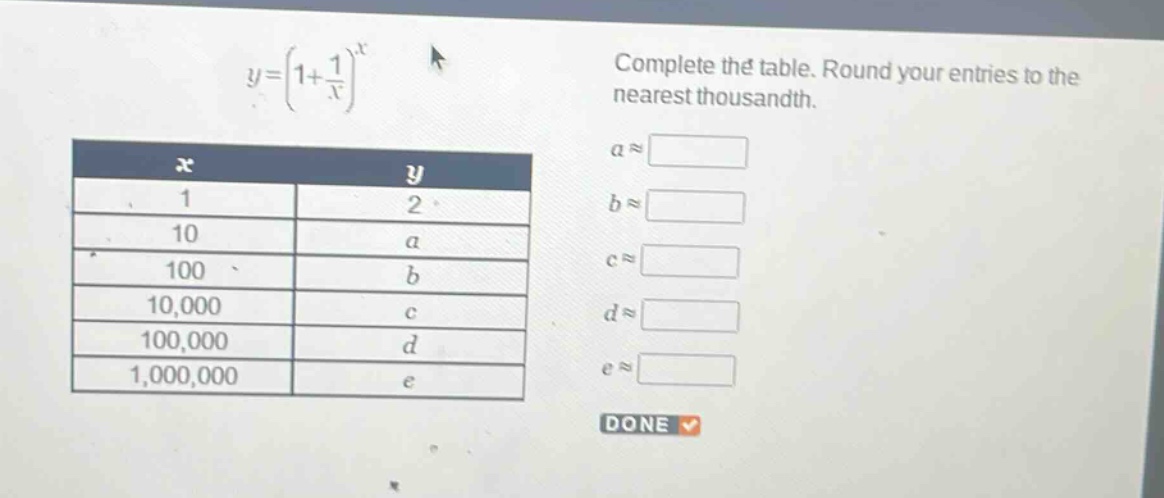
y=(1 + \\frac{1}{x})^x\ncomplete the table. round your entries to the nearest thousandth.\n| x | y |\n|----|----| \n| 1 | 2 |\n| 10 | a |\n| 100 | b |\n| 10,000 | c |\n| 100,000 | d |\n| 1,000,000 | e |\n a ≈\n b ≈\n c ≈\n d ≈\n e ≈\n done
Answer
Explanation:
Step1: Calculate value of (a)
Substitute (x = 10) into (y=(1+\frac{1}{x})^x), so (y=(1 + \frac{1}{10})^{10}=\left(\frac{11}{10}\right)^{10}\approx2.594).
Step2: Calculate value of (b)
Substitute (x = 100) into (y=(1+\frac{1}{x})^x), so (y=(1+\frac{1}{100})^{100}=\left(\frac{101}{100}\right)^{100}\approx2.705).
Step3: Calculate value of (c)
Substitute (x = 10000) into (y=(1+\frac{1}{x})^x), so (y=(1+\frac{1}{10000})^{10000}\approx2.718).
Step4: Calculate value of (d)
Substitute (x = 100000) into (y=(1+\frac{1}{x})^x), so (y=(1+\frac{1}{100000})^{100000}\approx2.718).
Step5: Calculate value of (e)
Substitute (x = 1000000) into (y=(1+\frac{1}{x})^x), so (y=(1+\frac{1}{1000000})^{1000000}\approx2.718).
Answer:
(a\approx2.594) (b\approx2.705) (c\approx2.718) (d\approx2.718) (e\approx2.718)