if $\frac{dy}{dx}=2 - y$, and if $y = 1$ when $x = 1$, then $y=$\n(a) $2 - e^{x - 1}$\n(b) $2 - e^{1…
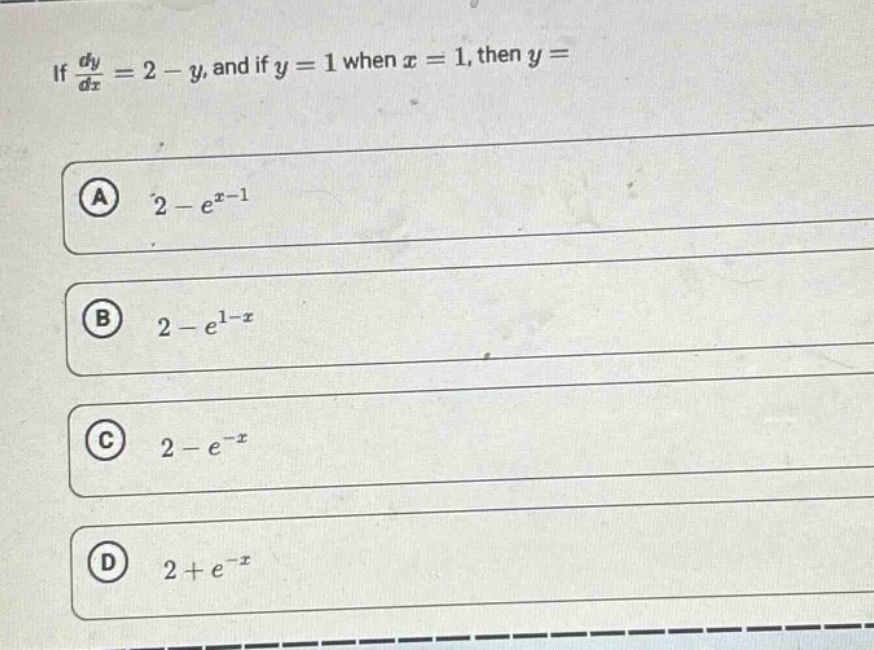
if $\frac{dy}{dx}=2 - y$, and if $y = 1$ when $x = 1$, then $y=$\n(a) $2 - e^{x - 1}$\n(b) $2 - e^{1 - x}$\n(c) $2 - e^{-x}$\n(d) $2 + e^{-x}$
Answer
Explanation:
Step1: Separate variables
We have the differential equation $\frac{dy}{dx}=2 - y$. Rearranging gives $\frac{dy}{2 - y}=dx$.
Step2: Integrate both sides
Integrating $\int\frac{dy}{2 - y}=\int dx$. Let $u = 2 - y$, then $du=-dy$. So, $-\int\frac{du}{u}=\int dx$. We get $-\ln|2 - y|=x + C$.
Step3: Solve for $y$
First, rewrite as $\ln|2 - y|=-x - C$. Then, exponentiate both sides: $|2 - y| = e^{-x - C}=e^{-C}e^{-x}$. Let $A = e^{-C}$, so $2 - y=\pm A e^{-x}$. We can write it as $y = 2+Be^{-x}$ (where $B= - \pm A$).
Step4: Use the initial - condition
Given $y = 1$ when $x = 1$. Substitute into $y = 2+Be^{-x}$: $1=2 + Be^{-1}$. Then $Be^{-1}=-1$, and $B=-e$.
Step5: Find the final form of $y$
Substitute $B = - e$ into $y = 2+Be^{-x}$, we get $y = 2 - e^{1 - x}$.
Answer:
B. $2 - e^{1 - x}$