frq1 task model h\ncalculator allowed\ngraph of f\n1. the function f is defined for -5≤x≤5, and consists of…
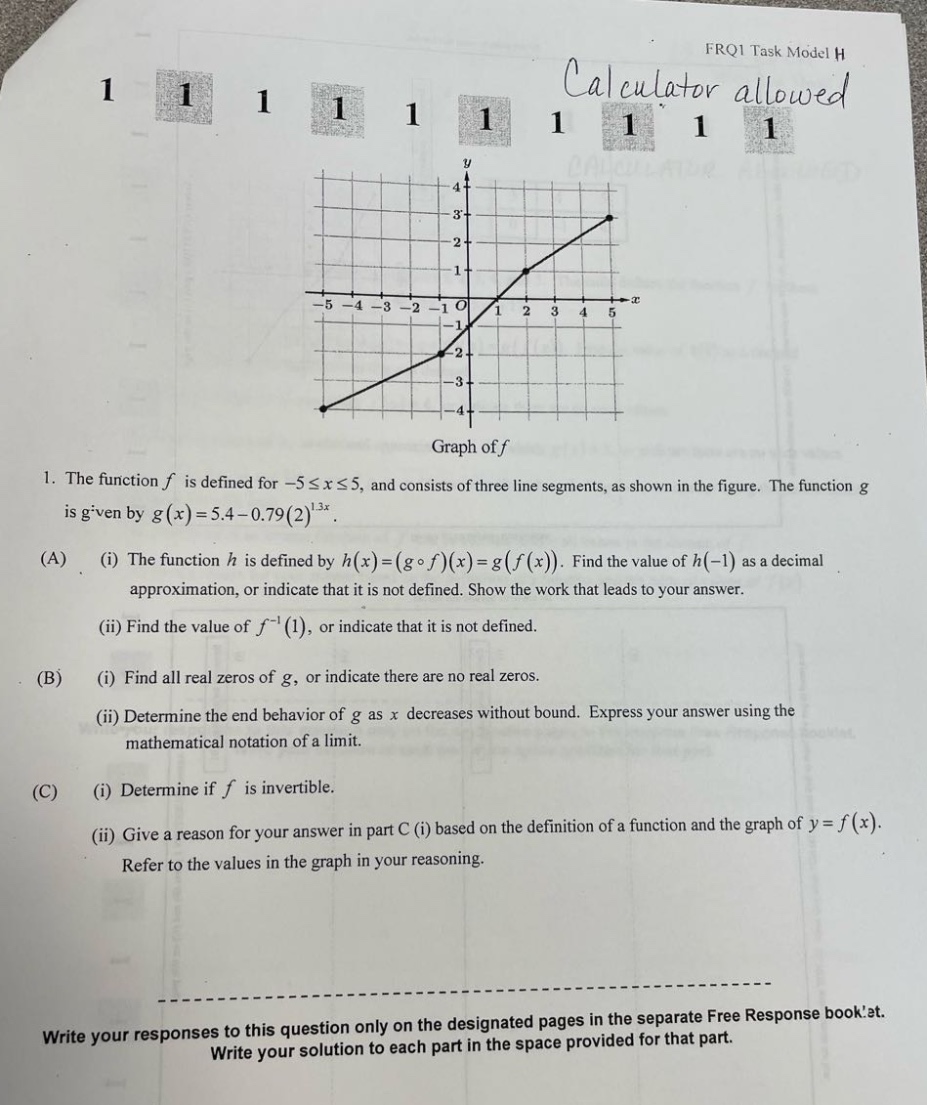
frq1 task model h\ncalculator allowed\ngraph of f\n1. the function f is defined for -5≤x≤5, and consists of three line - segments, as shown in the figure. the function g is given by g(x)=5.4 - 0.79(2)^1.3x.\n(a) (i) the function h is defined by h(x)=(g∘f)(x)=g(f(x)). find the value of h(-1) as a decimal approximation, or indicate that it is not defined. show the work that leads to your answer.\n(ii) find the value of f^(-1)(1), or indicate that it is not defined.\n(b) (i) find all real zeros of g, or indicate there are no real zeros.\n(ii) determine the end - behavior of g as x decreases without bound. express your answer using the mathematical notation of a limit.\n(c) (i) determine if f is invertible.\n(ii) give a reason for your answer in part c (i) based on the definition of a function and the graph of y = f(x). refer to the values in the graph in your reasoning.\nwrite your responses to this question only on the designated pages in the separate free response booklet. write your solution to each part in the space provided for that part.
Answer
Explanation:
Step1: Find (f(-1)) from the graph
From the graph of (y = f(x)), when (x=-1), (f(-1)= - 1).
Step2: Calculate (h(-1)=g(f(-1)))
Since (f(-1)=-1) and (g(x)=5.4 - 0.79(2)^{1.3x}), then (g(f(-1))=g(-1)=5.4-0.79(2)^{-1.3}). First, calculate ((2)^{-1.3}=\frac{1}{2^{1.3}}\approx\frac{1}{2.462}\approx0.406). Then (0.79\times(2)^{-1.3}\approx0.79\times0.406 = 0.32174). So (g(-1)=5.4 - 0.32174=5.07826\approx5.078).
Step3: Find (f^{-1}(1))
To find (f^{-1}(1)), we need to find the (x) - value such that (f(x)=1). From the graph of (y = f(x)), when (y = 1), (x = 2), so (f^{-1}(1)=2).
Step4: Find the zeros of (g(x))
Set (g(x)=0), so (5.4-0.79(2)^{1.3x}=0). Then (0.79(2)^{1.3x}=5.4), and ((2)^{1.3x}=\frac{5.4}{0.79}\approx6.835). Take the natural - logarithm of both sides: (1.3x\ln(2)=\ln(6.835)). (x=\frac{\ln(6.835)}{1.3\ln(2)}=\frac{1.922}{1.3\times0.693}=\frac{1.922}{0.9009}\approx2.13).
Step5: Determine the end - behavior of (g(x)) as (x\to-\infty)
We know that for the function (y = a\cdot b^{cx}) with (b > 1) and (c>0), (\lim_{x\to-\infty}b^{cx}=0). For (g(x)=5.4 - 0.79(2)^{1.3x}), (\lim_{x\to-\infty}g(x)=\lim_{x\to-\infty}(5.4 - 0.79(2)^{1.3x})=5.4-0.79\times0) (since (\lim_{x\to-\infty}(2)^{1.3x}=0)). So (\lim_{x\to-\infty}g(x)=5.4).
Step6: Determine if (f(x)) is invertible
The function (f(x)) is one - to - one (passes the horizontal line test). A function (y = f(x)) is invertible if and only if it is one - to - one. For any horizontal line (y = k) (where (k) is in the range of (f)), the horizontal line intersects the graph of (y = f(x)) at most once.
Answer:
(A) (i) (h(-1)\approx5.078) (ii) (f^{-1}(1)=2) (B) (i) (x\approx2.13) (ii) (\lim_{x\to-\infty}g(x)=5.4) (C) (i) (f) is invertible. (ii) The graph of (y = f(x)) passes the horizontal line test. For any horizontal line (y = k) in the range of (f), the horizontal line intersects the graph of (y = f(x)) at most once.