a 5 ft tall soccer player is running at 9 ft/sec, away from a big light source 42 ft above the ground. how…
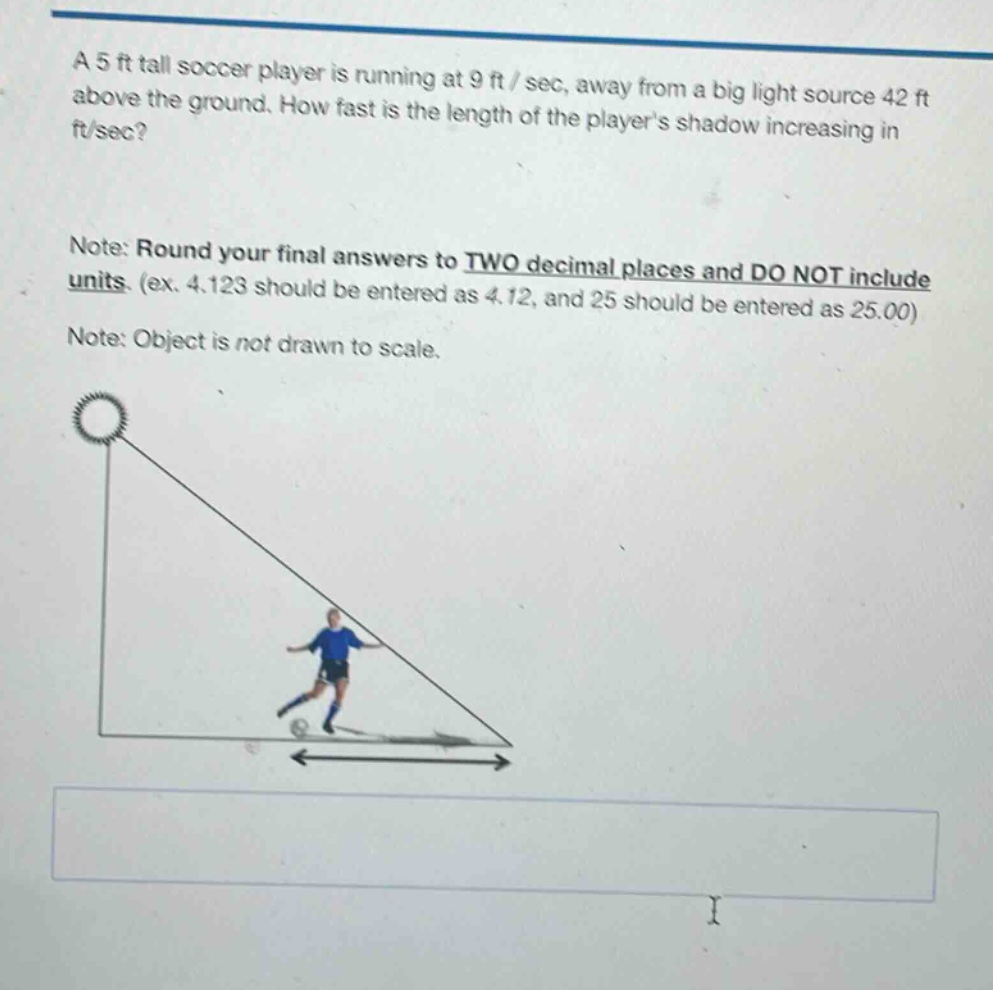
a 5 ft tall soccer player is running at 9 ft/sec, away from a big light source 42 ft above the ground. how fast is the length of the players shadow increasing in ft/sec? note: round your final answers to two decimal places and do not include units. (ex. 4.123 should be entered as 4.12, and 25 should be entered as 25.00) note: object is not drawn to scale.
Answer
Explanation:
Step1: Set up similar - triangles
Let $x$ be the distance of the player from the base of the light - source and $y$ be the length of the shadow. By similar triangles, we have $\frac{5}{42}=\frac{y}{x + y}$. Cross - multiply to get $5(x + y)=42y$, which simplifies to $5x+5y = 42y$, and then $5x = 37y$.
Step2: Differentiate with respect to time $t$
Differentiating both sides of $5x = 37y$ with respect to $t$, we use the chain rule. $\frac{d}{dt}(5x)=\frac{d}{dt}(37y)$. Since $\frac{dx}{dt}$ is the speed of the player and $\frac{dy}{dt}$ is the rate at which the shadow length is increasing, we have $5\frac{dx}{dt}=37\frac{dy}{dt}$.
Step3: Substitute the given value of $\frac{dx}{dt}$
We know that $\frac{dx}{dt}=9$ ft/sec. Substituting this into $5\frac{dx}{dt}=37\frac{dy}{dt}$, we get $5\times9 = 37\frac{dy}{dt}$. Then $\frac{dy}{dt}=\frac{45}{37}\approx1.22$.
Answer:
$1.22$