the function h(t)= - 5.2t² + 23t + 3.1 represents the height reached by a flying disc, in meters, t seconds…
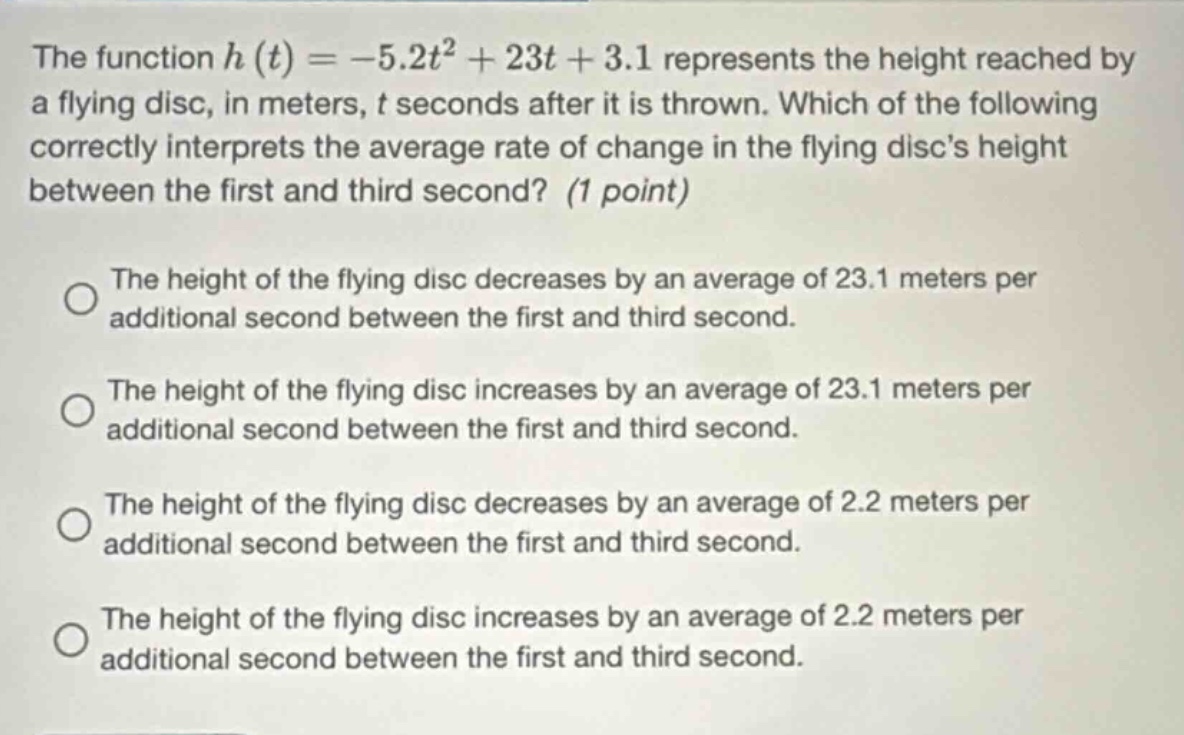
the function h(t)= - 5.2t² + 23t + 3.1 represents the height reached by a flying disc, in meters, t seconds after it is thrown. which of the following correctly interprets the average rate of change in the flying discs height between the first and third second? (1 point) the height of the flying disc decreases by an average of 23.1 meters per additional second between the first and third second. the height of the flying disc increases by an average of 23.1 meters per additional second between the first and third second. the height of the flying disc decreases by an average of 2.2 meters per additional second between the first and third second. the height of the flying disc increases by an average of 2.2 meters per additional second between the first and third second.
Answer
Explanation:
Step1: Recall average - rate - of - change formula
The average rate of change of a function $y = h(t)$ over the interval $[a,b]$ is $\frac{h(b)-h(a)}{b - a}$. Here, $a = 1$, $b = 3$, and $h(t)=-5.2t^{2}+23t + 3.1$.
Step2: Calculate $h(1)$
Substitute $t = 1$ into $h(t)$: $h(1)=-5.2\times(1)^{2}+23\times1 + 3.1=-5.2 + 23+3.1=20.9$.
Step3: Calculate $h(3)$
Substitute $t = 3$ into $h(t)$: $h(3)=-5.2\times(3)^{2}+23\times3 + 3.1=-5.2\times9+69 + 3.1=-46.8+69 + 3.1=25.3$.
Step4: Calculate average rate of change
$\frac{h(3)-h(1)}{3 - 1}=\frac{25.3 - 20.9}{2}=\frac{4.4}{2}=2.2$. Since the result is positive, the height of the flying disc increases by an average of 2.2 meters per additional second between the first and third second.
Answer:
The height of the flying disc increases by an average of 2.2 meters per additional second between the first and third second.