for the function f(x)=x^3 - 3x, its local maximum is which occurs at ( its local minimum is which occurs at (
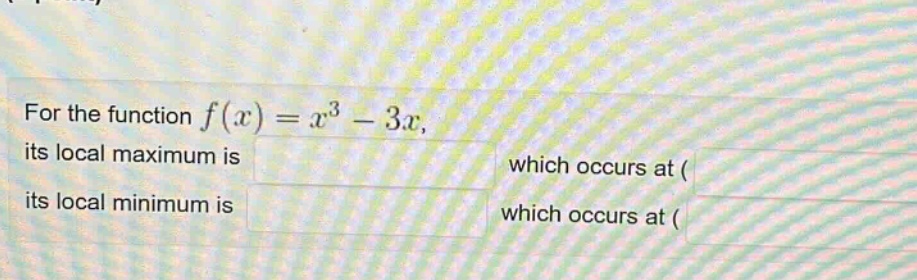
for the function f(x)=x^3 - 3x, its local maximum is which occurs at ( its local minimum is which occurs at (
Answer
Explanation:
Step1: Find the derivative
Differentiate $f(x)=x^{3}-3x$ using the power - rule. The derivative $f^\prime(x)=3x^{2}-3$.
Step2: Set the derivative equal to zero
Solve $3x^{2}-3 = 0$. First, factor out 3: $3(x^{2}-1)=0$, then $x^{2}-1=(x + 1)(x - 1)=0$. So $x=-1$ or $x = 1$.
Step3: Use the second - derivative test
Differentiate $f^\prime(x)$ to get the second - derivative $f^{\prime\prime}(x)=6x$. When $x=-1$, $f^{\prime\prime}(-1)=6\times(-1)=-6<0$. So $f(x)$ has a local maximum at $x=-1$. Substitute $x=-1$ into $f(x)$: $f(-1)=(-1)^{3}-3\times(-1)=-1 + 3=2$. When $x = 1$, $f^{\prime\prime}(1)=6\times1=6>0$. So $f(x)$ has a local minimum at $x = 1$. Substitute $x = 1$ into $f(x)$: $f(1)=1^{3}-3\times1=1 - 3=-2$.
Answer:
Its local maximum is 2, which occurs at $x=-1$. Its local minimum is -2, which occurs at $x = 1$.