the function f(x)=−6x³−63x²+144x + 4 is increasing on the interval ( , ). it is decreasing on the interval…
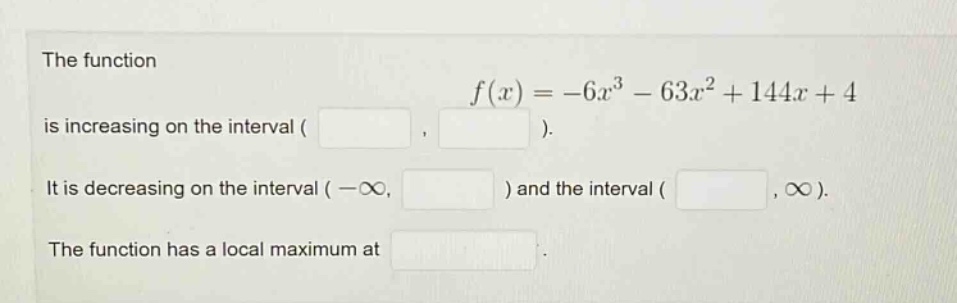
the function f(x)=−6x³−63x²+144x + 4 is increasing on the interval ( , ). it is decreasing on the interval (−∞, ) and the interval ( ,∞). the function has a local maximum at .
Answer
Explanation:
Step1: Find the derivative
Differentiate $f(x)=-6x^{3}-63x^{2}+144x + 4$ using the power - rule $(x^n)'=nx^{n - 1}$. $f'(x)=-18x^{2}-126x + 144$
Step2: Set the derivative equal to zero
$-18x^{2}-126x + 144 = 0$. Divide through by $-18$ to simplify: $x^{2}+7x - 8=0$. Factor the quadratic equation: $(x + 8)(x - 1)=0$. The critical points are $x=-8$ and $x = 1$.
Step3: Determine the sign of the derivative
Choose test points in the intervals $(-\infty,-8)$, $(-8,1)$ and $(1,\infty)$. For the interval $(-\infty,-8)$, let $x=-9$. Then $f'(-9)=-18\times(-9)^{2}-126\times(-9)+144=-18\times81 + 1134+144=-1458+1134 + 144=-180<0$. For the interval $(-8,1)$, let $x = 0$. Then $f'(0)=-18\times0^{2}-126\times0 + 144=144>0$. For the interval $(1,\infty)$, let $x = 2$. Then $f'(2)=-18\times2^{2}-126\times2+144=-18\times4-252 + 144=-72-252+144=-180<0$.
Answer:
The function is increasing on the interval $(-8,1)$. It is decreasing on the interval $(-\infty,-8)$ and the interval $(1,\infty)$. The function has a local maximum at $x = 1$.