the function f(x)=(x + 5)/(x²+7x + 10) is a rational function.\na. determine the coordinates of any…
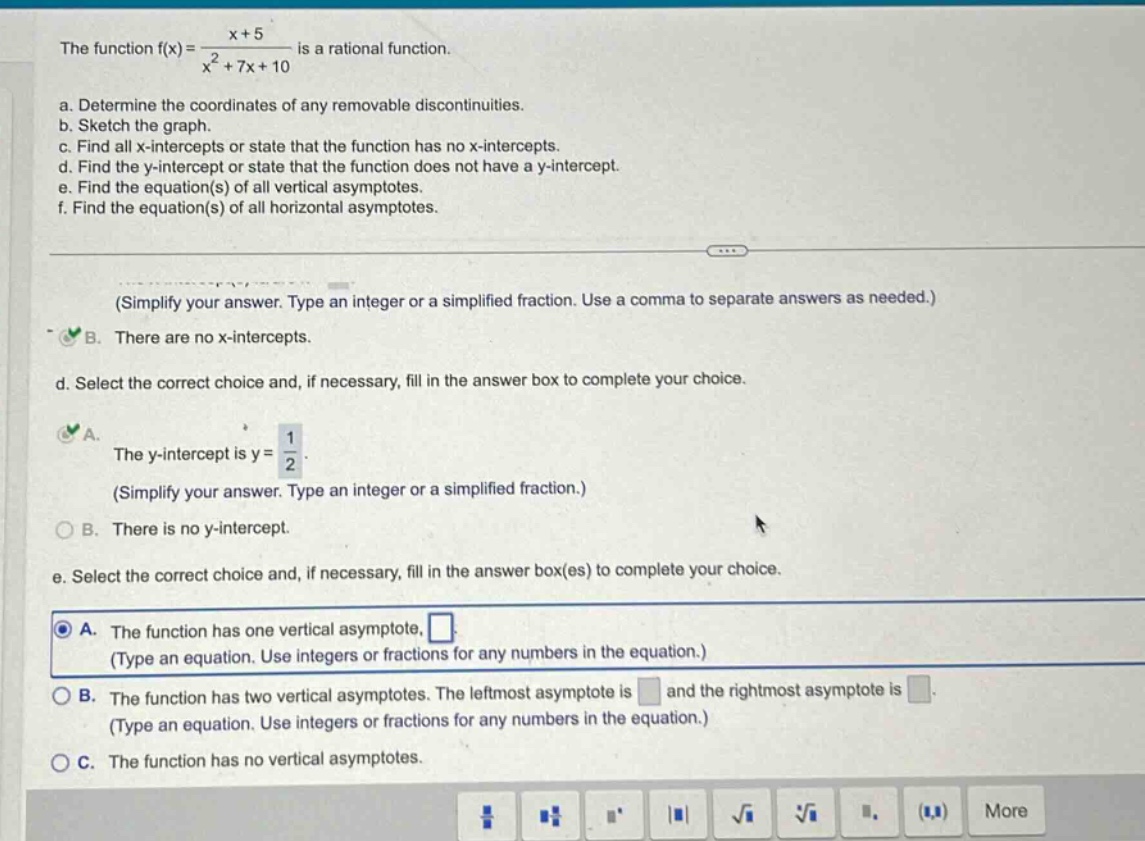
the function f(x)=(x + 5)/(x²+7x + 10) is a rational function.\na. determine the coordinates of any removable discontinuities.\nb. sketch the graph.\nc. find all x - intercepts or state that the function has no x - intercepts.\nd. find the y - intercept or state that the function does not have a y - intercept.\ne. find the equation(s) of all vertical asymptotes.\nf. find the equation(s) of all horizontal asymptotes.\n(simplify your answer. type an integer or a simplified fraction. use a comma to separate answers as needed.)\nb. there are no x - intercepts.\nd. select the correct choice and, if necessary, fill in the answer box to complete your choice.\na. the y - intercept is y = 1/2. (simplify your answer. type an integer or a simplified fraction.)\nb. there is no y - intercept.\ne. select the correct choice and, if necessary, fill in the answer box(es) to complete your choice.\na. the function has one vertical asymptote. (type an equation. use integers or fractions for any numbers in the equation.)\nb. the function has two vertical asymptotes. the leftmost asymptote is and the rightmost asymptote is (type an equation. use integers or fractions for any numbers in the equation.)\nc. the function has no vertical asymptotes.
Answer
Explanation:
Step1: Simplify the rational - function
First, factor the denominator $x^{2}+7x + 10=(x + 2)(x+5)$. So, $f(x)=\frac{x + 5}{(x + 2)(x + 5)}=\frac{1}{x + 2},x\neq - 5$.
Step2: Find removable discontinuities
A removable discontinuity occurs when a factor in the numerator and denominator cancels out. Set the canceled - out factor equal to zero. Since $x+5$ is the canceled factor, $x=-5$. Substitute $x = - 5$ into the simplified function $y=\frac{1}{x + 2}$, we get $y=-1$. So the removable discontinuity is at the point $(-5,-1)$.
Step3: Find x - intercepts
Set $y = 0$. For $y=\frac{1}{x + 2}$, when $\frac{1}{x + 2}=0$, there is no solution because the numerator is non - zero. So there are no x - intercepts.
Step4: Find y - intercept
Set $x = 0$. Then $y=\frac{1}{0 + 2}=\frac{1}{2}$.
Step5: Find vertical asymptotes
Set the denominator of the simplified function equal to zero. For $y=\frac{1}{x + 2}$, when $x+2=0$, we have $x=-2$. So the vertical asymptote is $x=-2$.
Step6: Find horizontal asymptotes
Since the degree of the numerator is less than the degree of the denominator in the simplified function $y=\frac{1}{x + 2}$, the horizontal asymptote is $y = 0$.
Answer:
a. $(-5,-1)$ b. (Sketching requires graphical tools. The graph has a hole at $(-5,-1)$, a vertical asymptote at $x=-2$, a horizontal asymptote at $y = 0$, and a y - intercept at $(0,\frac{1}{2})$) c. B. There are no x - intercepts. d. A. The y - intercept is $y=\frac{1}{2}$ e. A. The function has one vertical asymptote, $x=-2$ f. The function has one horizontal asymptote, $y = 0$