the function n(t)= (0.9t + 900)/(5t + 7), t≥15, gives the body concentration n(t), in parts per million, of…
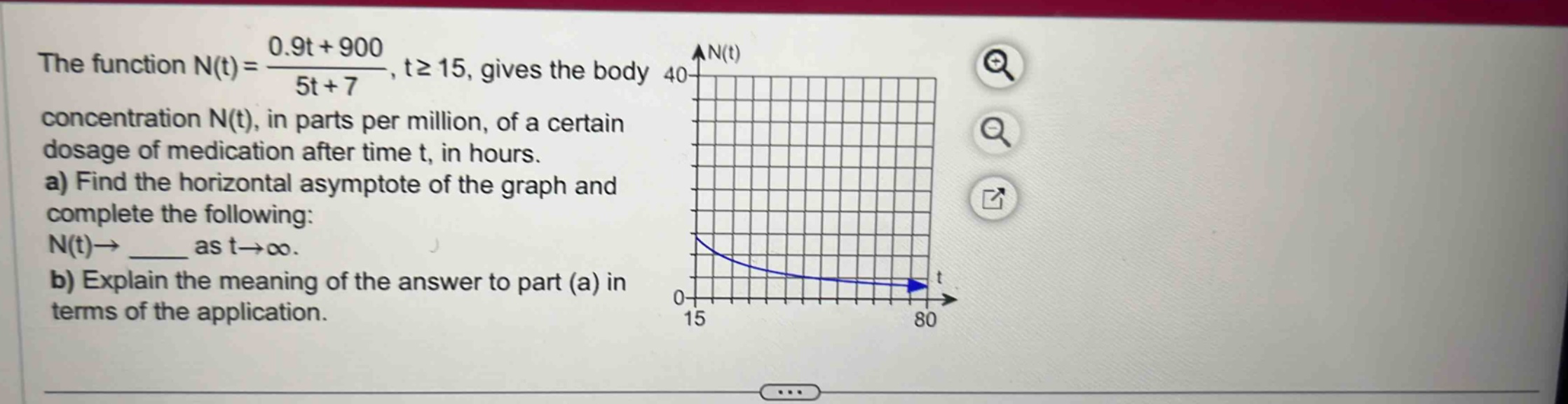
the function n(t)= (0.9t + 900)/(5t + 7), t≥15, gives the body concentration n(t), in parts per million, of a certain dosage of medication after time t, in hours. a) find the horizontal asymptote of the graph and complete the following: n(t)→ ____ as t→∞. b) explain the meaning of the answer to part (a) in terms of the application.
Answer
Explanation:
Step1: Identify the degrees of polynomials
The function $N(t)=\frac{0.9t + 900}{5t+7}$ is a rational - function. The degree of the numerator $n = 1$ (highest power of $t$ in $0.9t + 900$) and the degree of the denominator $m = 1$ (highest power of $t$ in $5t + 7$).
Step2: Use the horizontal - asymptote rule for rational functions
When $n=m$, the horizontal asymptote $y$ of the rational function $y=\frac{a_nx^n+\cdots+a_0}{b_mx^m+\cdots + b_0}$ is given by $y=\frac{a_n}{b_m}$. Here, $a_n = 0.9$ and $b_m=5$. So, $y=\frac{0.9}{5}=0.18$.
Step3: Interpret the result for part (b)
As $t\to\infty$, the body - concentration $N(t)$ of the medication approaches $0.18$ parts per million. This means that as time goes on (a long time after taking the medication), the concentration of the medication in the body will get closer and closer to $0.18$ parts per million.
Answer:
a) $N(t)\to0.18$ as $t\to\infty$. b) As time goes on (a long time after taking the medication), the concentration of the medication in the body will approach $0.18$ parts per million.