the function n(t) = (0.9t + 900)/(5t + 7), t≥15, gives the body concentration n(t), in parts per million, of…
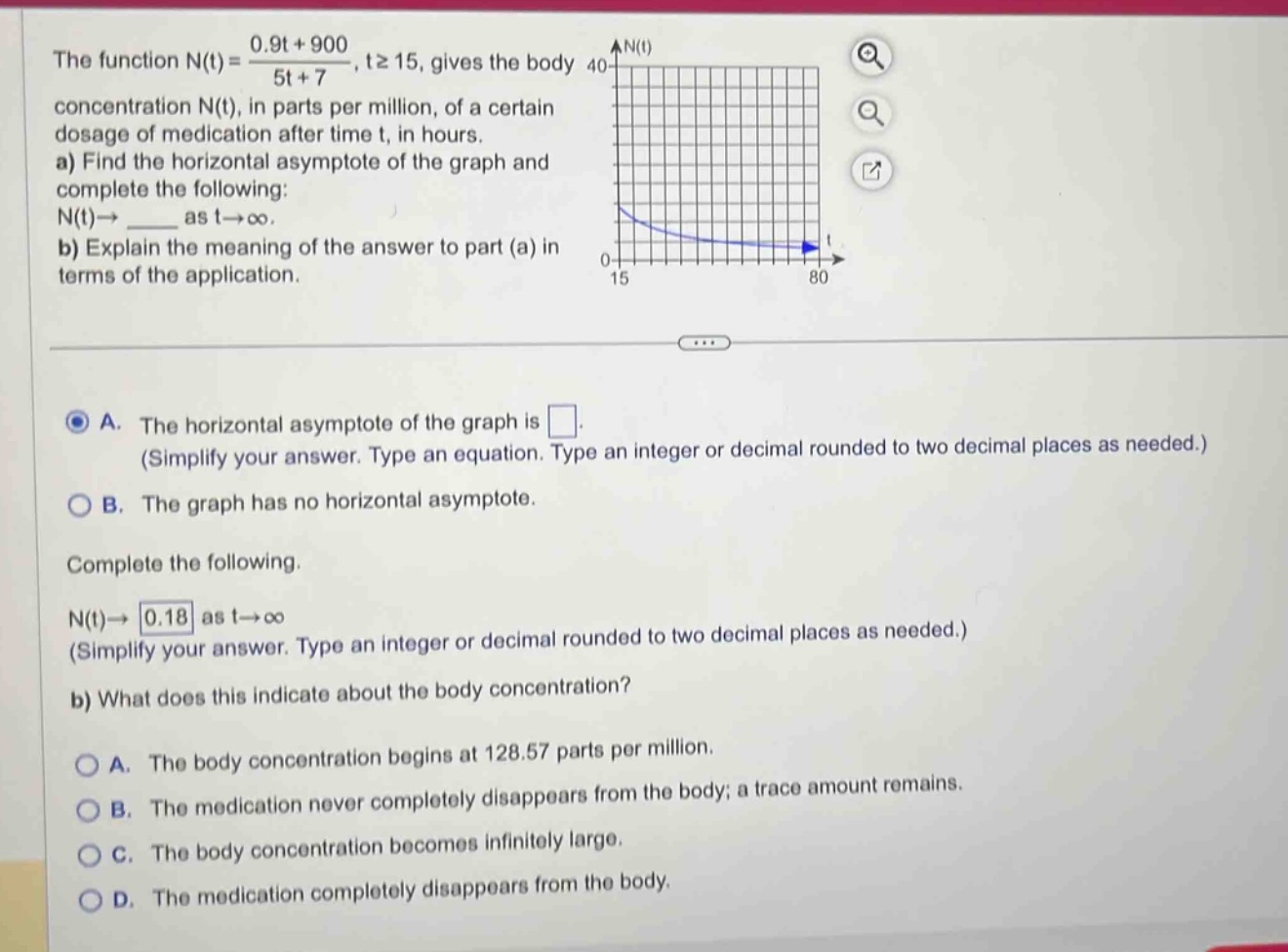
the function n(t) = (0.9t + 900)/(5t + 7), t≥15, gives the body concentration n(t), in parts per million, of a certain dosage of medication after time t, in hours. a) find the horizontal asymptote of the graph and complete the following: n(t)→____ as t→∞. b) explain the meaning of the answer to part (a) in terms of the application. a. the horizontal asymptote of the graph is . (simplify your answer. type an equation. type an integer or decimal rounded to two decimal places as needed.) b. the graph has no horizontal asymptote. complete the following. n(t)→0.18 as t→∞ (simplify your answer. type an integer or decimal rounded to two decimal places as needed.) b) what does this indicate about the body concentration? a. the body concentration begins at 128.57 parts per million. b. the medication never completely disappears from the body; a trace amount remains. c. the body concentration becomes infinitely large. d. the medication completely disappears from the body.
Answer
Explanation:
Step1: Identify the degrees of numerator and denominator
The function is $N(t)=\frac{0.9t + 900}{5t+7}$, where the degree of the numerator and denominator is 1.
Step2: Find the horizontal - asymptote
For a rational function $\frac{at + b}{ct + d}$ with degree of numerator = degree of denominator, the horizontal asymptote is $y=\frac{a}{c}$. Here $a = 0.9$ and $c = 5$, so $y=\frac{0.9}{5}=0.18$.
Step3: Interpret the horizontal asymptote
As $t\rightarrow\infty$, the body - concentration $N(t)$ approaches 0.18 parts per million. This means that the medication never completely disappears from the body; a trace amount remains.
Answer:
a) A. The horizontal asymptote of the graph is $y = 0.18$ b) B. The medication never completely disappears from the body; a trace amount remains.