the function f is an antiderivative of the function g defined by g(x)=3 - √(x² + x + 4cosx). which of the…
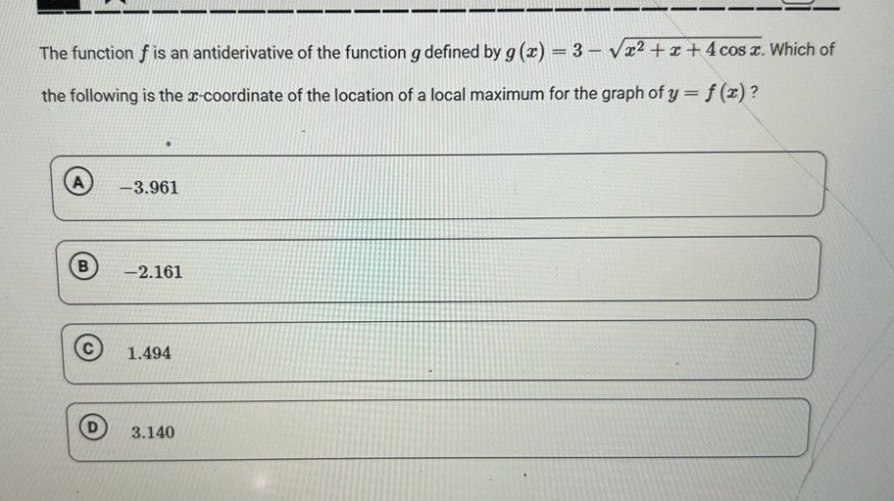
the function f is an antiderivative of the function g defined by g(x)=3 - √(x² + x + 4cosx). which of the following is the x - coordinate of the location of a local maximum for the graph of y = f(x)? a -3.961 b -2.161 c 1.494 d 3.140
Answer
Explanation:
Step1: Recall the relationship between $f$ and $g$
Since $f$ is an antiderivative of $g$, then $f^\prime(x)=g(x)$. Local - maxima of $y = f(x)$ occur where $f^\prime(x)=g(x) = 0$ and $f^{\prime\prime}(x)=g^\prime(x)<0$. First, set $g(x)=3-\sqrt{x^{2}+x + 4\cos x}=0$. Then $\sqrt{x^{2}+x + 4\cos x}=3$, and $x^{2}+x + 4\cos x = 9$.
Step2: Use a graphing utility or numerical method
We can use a graphing calculator or a numerical root - finding algorithm (such as Newton - Raphson method) to find the roots of the equation $x^{2}+x + 4\cos x-9 = 0$. Another way is to graph $y = g(x)=3-\sqrt{x^{2}+x + 4\cos x}$ and find the $x$ - values where $y = 0$. Then, we can check the sign of $g^\prime(x)$ at those points. Differentiate $g(x)$ using the chain - rule. Let $u=x^{2}+x + 4\cos x$, then $g(x)=3 - u^{\frac{1}{2}}$. $g^\prime(x)=-\frac{1}{2\sqrt{x^{2}+x + 4\cos x}}(2x + 1-4\sin x)$. By using a graphing utility to graph $y = g(x)$ and finding its $x$ - intercepts and then checking the sign of $g^\prime(x)$ at those points, we find that the $x$ - coordinate of the local maximum of $y = f(x)$ (where $g(x)=0$ and $g^\prime(x)<0$) is approximately $x=-3.961$.
Answer:
A. $-3.961$