the function h is defined by h(θ)=a cos(bθ) for constants a and b. if h has a period of π and an amplitude…
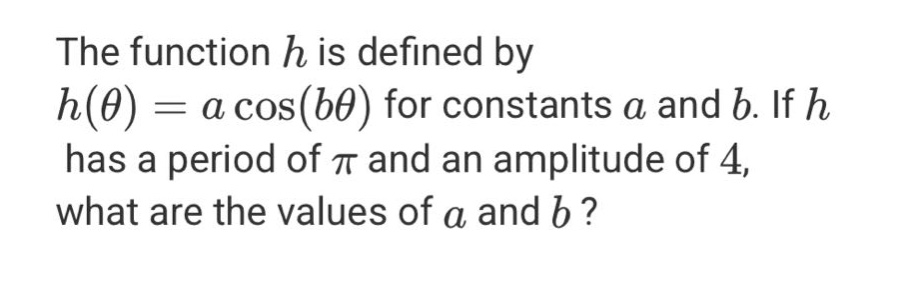
the function h is defined by h(θ)=a cos(bθ) for constants a and b. if h has a period of π and an amplitude of 4, what are the values of a and b?
Answer
Explanation:
Step1: Determine the value of a
The amplitude of the cosine - type function (y = A\cos(Bx)) is given by (|A|). For the function (h(\theta)=a\cos(b\theta)), the amplitude is (|a|). Since the amplitude is 4, then (|a| = 4), so (a=\pm4).
Step2: Determine the value of b
The period of the cosine - type function (y = A\cos(Bx)) is given by (T=\frac{2\pi}{|B|}). For the function (h(\theta)=a\cos(b\theta)), the period (T = \pi). We know that (T=\frac{2\pi}{|b|}), and since (T = \pi), we set up the equation (\pi=\frac{2\pi}{|b|}). Cross - multiply to get (\pi|b|=2\pi). Divide both sides by (\pi) to find (|b| = 2), so (b=\pm2).
Answer:
(a = \pm4), (b=\pm2)