the function f is defined as ( f(x)=(x - 2)^2(x + 4) ). the cubic function ( g(x) ) has a double root at -1…
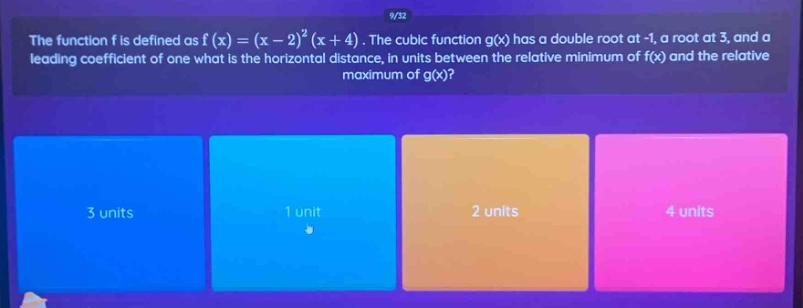
the function f is defined as ( f(x)=(x - 2)^2(x + 4) ). the cubic function ( g(x) ) has a double root at -1, a root at 3, and a leading coefficient of one what is the horizontal distance, in units between the relative minimum of ( f(x) ) and the relative maximum of ( g(x) )?
Answer
Explanation:
Step1: Find the derivative of (f(x))
Given (f(x)=(x - 2)^{2}(x + 4)). Expand (f(x)=(x^{2}-4x + 4)(x + 4)=x^{3}-4x^{2}+4x+4x^{2}-16x + 16=x^{3}-12x + 16). The derivative (f^\prime(x)=3x^{2}-12). Set (f^\prime(x)=0), then (3x^{2}-12 = 0), (x^{2}=4), (x=\pm2). Use the second - derivative test: (f^{\prime\prime}(x)=6x). When (x = 2), (f^{\prime\prime}(2)=12>0), so (x = 2) is the (x) - value of the relative minimum of (f(x)).
Step2: Write the equation of (g(x))
Since (g(x)) is a cubic function with a double root at (x=-1) and a root at (x = 3) and leading coefficient (a = 1), then (g(x)=(x + 1)^{2}(x - 3)=(x^{2}+2x + 1)(x - 3)=x^{3}+2x^{2}+x-3x^{2}-6x - 3=x^{3}-x^{2}-5x - 3). The derivative (g^\prime(x)=3x^{2}-2x - 5). Set (g^\prime(x)=0), then (3x^{2}-2x - 5=(3x - 5)(x + 1)=0), (x=-1) or (x=\frac{5}{3}). Use the second - derivative test: (g^{\prime\prime}(x)=6x-2). When (x=-1), (g^{\prime\prime}(-1)=6\times(-1)-2=-8<0), so (x=-1) is the (x) - value of the relative maximum of (g(x)).
Step3: Calculate the horizontal distance
The horizontal distance (d=\vert2-(-1)\vert=3) units.
Answer:
3 units