the function f is defined above. which of the following statements is true? a f is continuous at x = 2. b f…
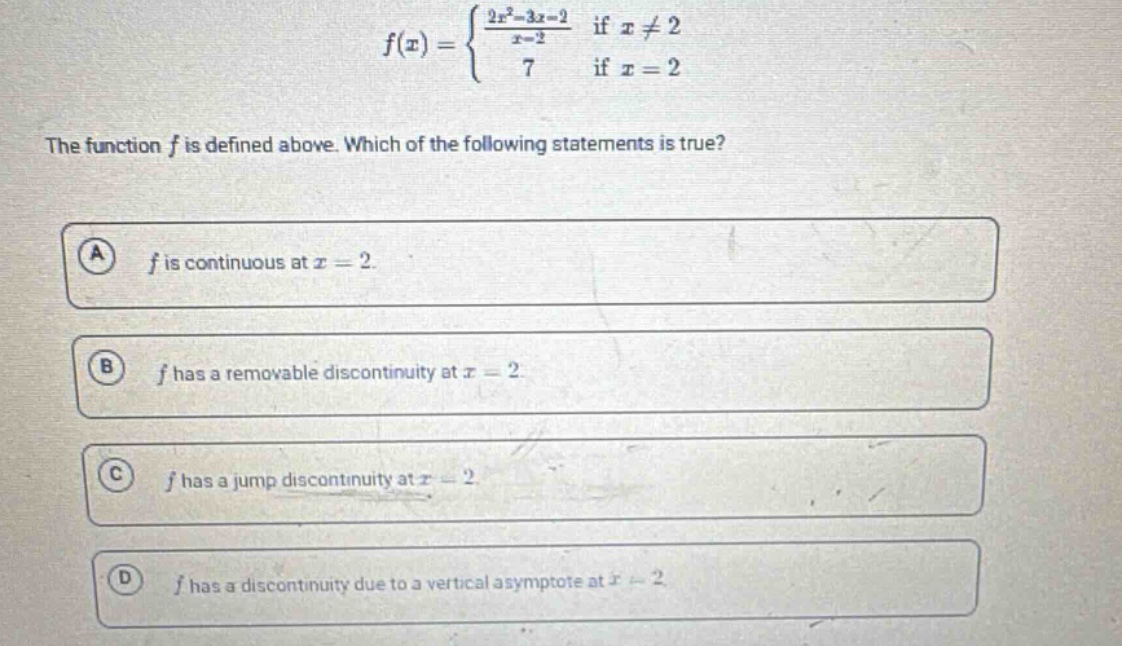
the function f is defined above. which of the following statements is true? a f is continuous at x = 2. b f has a removable discontinuity at x = 2 c f has a jump discontinuity at x = 2 d f has a discontinuity due to a vertical asymptote at x = 2
Answer
Explanation:
Step1: Simplify the function for $x\neq2$
Factor the numerator of $\frac{2x^{2}-3x - 2}{x - 2}$. We have $2x^{2}-3x - 2=(2x + 1)(x - 2)$. So $\frac{2x^{2}-3x - 2}{x - 2}=\frac{(2x + 1)(x - 2)}{x - 2}=2x + 1$ for $x\neq2$.
Step2: Find the limit as $x$ approaches 2
$\lim_{x\rightarrow2}\frac{2x^{2}-3x - 2}{x - 2}=\lim_{x\rightarrow2}(2x + 1)$. Substitute $x = 2$ into $2x+1$, we get $\lim_{x\rightarrow2}(2x + 1)=2\times2+1 = 5$.
Step3: Evaluate the function at $x = 2$
$f(2)=7$.
Step4: Analyze the continuity
Since $\lim_{x\rightarrow2}f(x)=5$ and $f(2)=7$, $\lim_{x\rightarrow2}f(x)\neq f(2)$. But the limit exists. A removable - discontinuity occurs when the limit of a function exists at a point but the function is either undefined or has a different value at that point.
Answer:
B. $f$ has a removable discontinuity at $x = 2$