the function h is defined by h(x) = (x² - 7)/(x - 3). which of the following statements must be true? a lim…
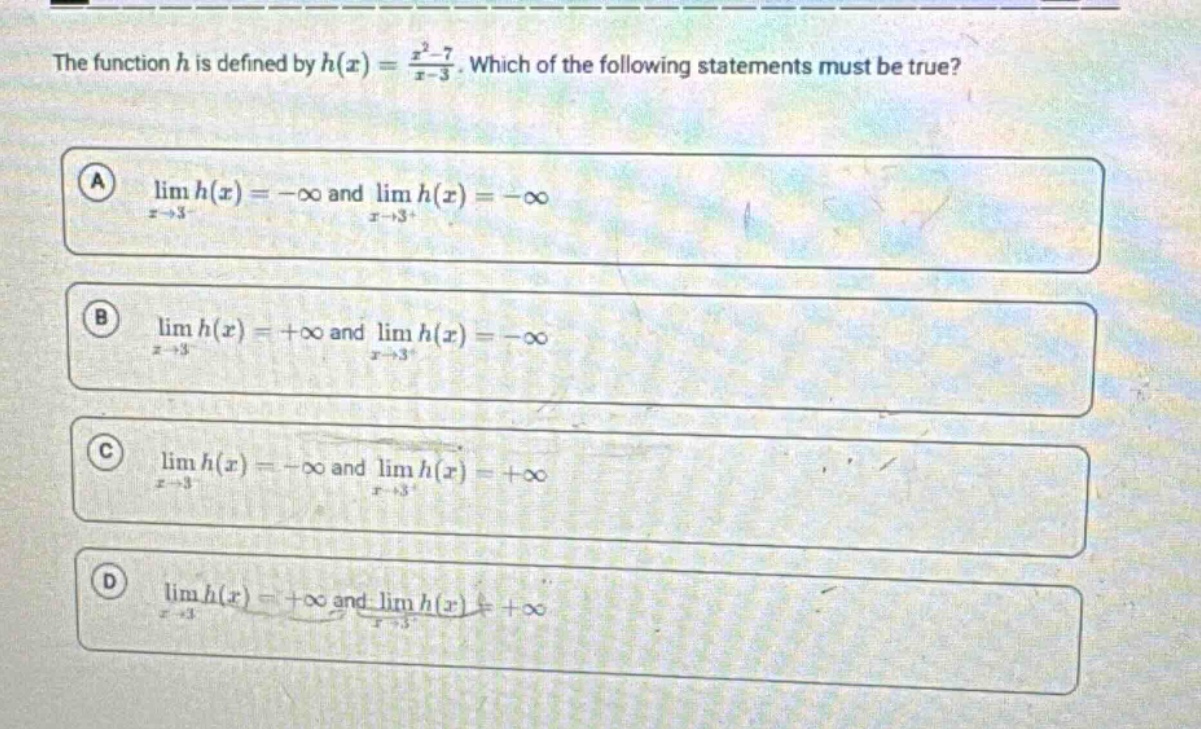
the function h is defined by h(x) = (x² - 7)/(x - 3). which of the following statements must be true? a lim h(x) = -∞ and lim h(x) = -∞ as x→3⁻ and x→3⁺ b lim h(x) = +∞ and lim h(x) = -∞ as x→3⁻ and x→3⁺ c lim h(x) = -∞ and lim h(x) = +∞ as x→3⁻ and x→3⁺ d lim h(x) = +∞ and lim h(x) = +∞ as x→3⁻ and x→3⁺
Answer
Explanation:
Step1: Analyze left - hand limit
When $x\to3^{-}$, we consider values of $x$ that are less than 3 but approaching 3. Let's analyze the sign of the numerator and denominator of $h(x)=\frac{x^{2}-7}{x - 3}$. The numerator $x^{2}-7$ when $x\to3^{-}$ is $3^{2}-7=9 - 7 = 2>0$. The denominator $x - 3$ when $x\to3^{-}$ is a small negative number. So, $\lim_{x\to3^{-}}h(x)=\frac{2}{\text{small negative number}}=-\infty$.
Step2: Analyze right - hand limit
When $x\to3^{+}$, we consider values of $x$ that are greater than 3 but approaching 3. The numerator $x^{2}-7$ when $x\to3^{+}$ is still $3^{2}-7 = 2>0$. The denominator $x - 3$ when $x\to3^{+}$ is a small positive number. So, $\lim_{x\to3^{+}}h(x)=\frac{2}{\text{small positive number}}=+\infty$.
Answer:
C. $\lim_{x\to3^{-}}h(x)=-\infty$ and $\lim_{x\to3^{+}}h(x)=+\infty$