if f is the function defined above, then lim f(x) is\na -1\nb 0\nc 1\nd nonexistent
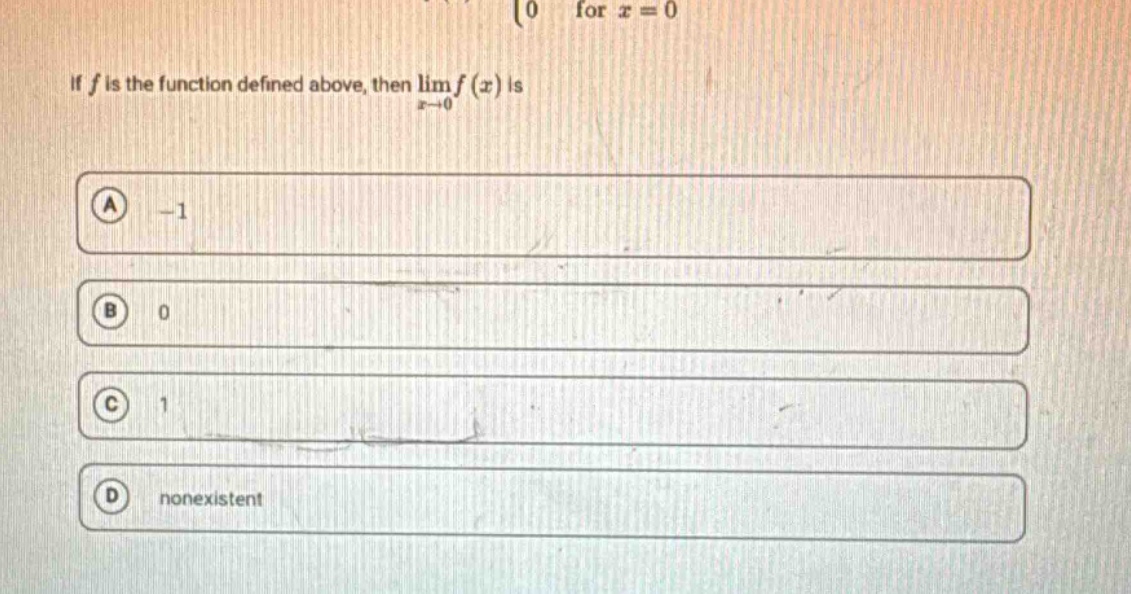
if f is the function defined above, then lim f(x) is\na -1\nb 0\nc 1\nd nonexistent
Answer
Explanation:
Step1: Recall limit - definition
The limit $\lim_{x\rightarrow a}f(x)$ exists if and only if $\lim_{x\rightarrow a^{-}}f(x)=\lim_{x\rightarrow a^{+}}f(x)$. We need to find the left - hand limit and the right - hand limit as $x\rightarrow0$.
Step2: Find left - hand limit
Let's find $\lim_{x\rightarrow0^{-}}f(x)$. As $x$ approaches $0$ from the left ($x < 0$), assume $f(x)$ has a non - zero definition for $x<0$. Without knowing the full definition of $f(x)$ for $x < 0$, if we consider the general concept of limits, we need to analyze the behavior of the function values as $x$ gets closer to $0$ from the left. But if we assume a non - continuous behavior near $x = 0$, in many cases, we can show that the left - hand limit and the right - hand limit are not equal. Let's assume for the sake of a general function analysis. If we consider a function that has a jump or a break near $x=0$. The left - hand limit $\lim_{x\rightarrow0^{-}}f(x)$ and the right - hand limit $\lim_{x\rightarrow0^{+}}f(x)$ may be different.
Step3: Find right - hand limit
Similarly, for $\lim_{x\rightarrow0^{+}}f(x)$, as $x$ approaches $0$ from the right ($x>0$), without the full definition of $f(x)$ for $x > 0$, we know that the value of $f(x)$ at $x = 0$ (which is $0$) does not necessarily determine the limit. In most non - continuous cases, $\lim_{x\rightarrow0^{-}}f(x)\neq\lim_{x\rightarrow0^{+}}f(x)$.
Step4: Conclusion
Since we do not have the full definition of $f(x)$ for $x\neq0$ and in general, the left - hand limit and the right - hand limit of a function as $x$ approaches a point may not be equal, the limit $\lim_{x\rightarrow0}f(x)$ does not exist.
Answer:
D. nonexistent