function f is defined by f(x)=ln(x). which of the following statements describes a function that has a…
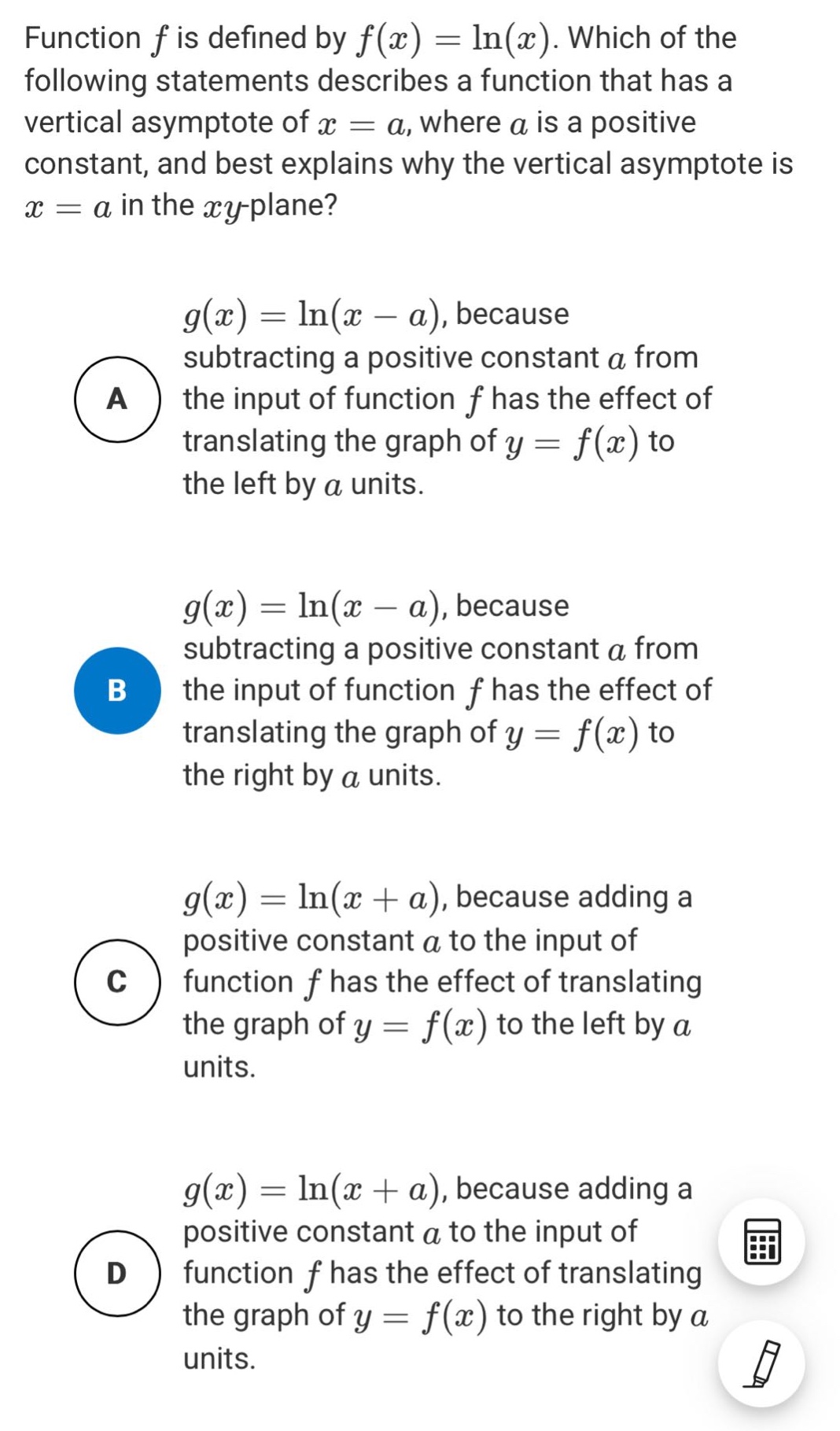
function f is defined by f(x)=ln(x). which of the following statements describes a function that has a vertical asymptote of x = a, where a is a positive constant, and best explains why the vertical asymptote is x = a in the xy - plane? a g(x)=ln(x - a), because subtracting a positive constant a from the input of function f has the effect of translating the graph of y = f(x) to the left by a units. b g(x)=ln(x - a), because subtracting a positive constant a from the input of function f has the effect of translating the graph of y = f(x) to the right by a units. c g(x)=ln(x + a), because adding a positive constant a to the input of function f has the effect of translating the graph of y = f(x) to the left by a units. d g(x)=ln(x + a), because adding a positive constant a to the input of function f has the effect of translating the graph of y = f(x) to the right by a units.
Answer
Explanation:
Step1: Recall function - translation rule
For a function (y = f(x)), the transformation (y=f(x - h)) translates the graph of (y = f(x)) to the right by (h) units, and (y = f(x+h)) translates the graph of (y = f(x)) to the left by (h) units.
Step2: Recall vertical - asymptote of the natural - logarithm function
The function (y=\ln(x)) has a vertical asymptote at (x = 0). We want a function with a vertical asymptote at (x=a) ((a>0)). If we start with (y = \ln(x)) and consider the function (g(x)=\ln(x - a)), when (x=a), (g(x)=\ln(0)) which is undefined. As (x\to a^{+}), (g(x)\to-\infty). So the vertical asymptote of (y = \ln(x - a)) is (x=a) because subtracting (a) from (x) in (y=\ln(x)) shifts the graph of (y = \ln(x)) to the right by (a) units.
Answer:
B. (g(x)=\ln(x - a)), because subtracting a positive constant (a) from the input of function (f) has the effect of translating the graph of (y = f(x)) to the right by (a) units.