the function f is defined by f(x) = sin x, and the domain of f is 3π/2 < x < 2π. which of the following is…
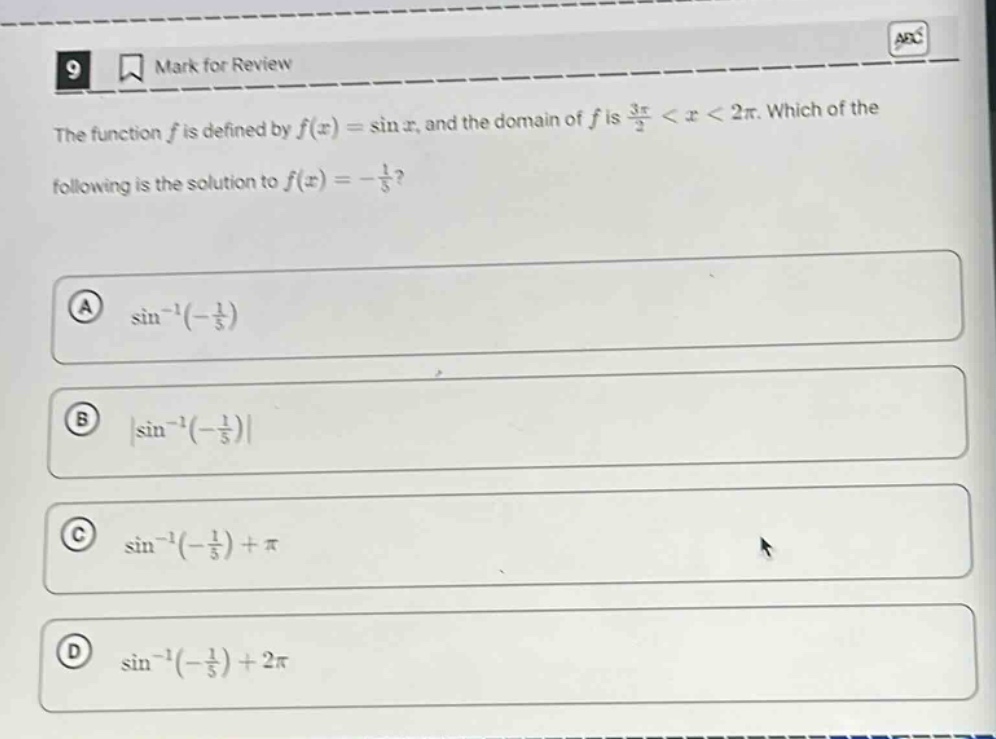
the function f is defined by f(x) = sin x, and the domain of f is 3π/2 < x < 2π. which of the following is the solution to f(x) = -1/5? a sin^(-1)(-1/5) b |sin^(-1)(-1/5)| c sin^(-1)(-1/5) + π d sin^(-1)(-1/5) + 2π
Answer
Explanation:
Step1: Recall the range of inverse - sine function
The inverse - sine function (y = \sin^{-1}(x)) has a range of (-\frac{\pi}{2}\leq y\leq\frac{\pi}{2}). Given (f(x)=\sin x=-\frac{1}{5}), the principal value of (x) is (x_0 = \sin^{-1}(-\frac{1}{5})) which lies in ([-\frac{\pi}{2},0]).
Step2: Adjust for the given domain (\frac{3\pi}{2}<x<2\pi)
We know that the sine function has a period of (2\pi), i.e., (\sin(x)=\sin(x + 2k\pi)) for (k\in\mathbb{Z}). To get a value of (x) in the domain (\frac{3\pi}{2}<x<2\pi), we add (2\pi) to the principal - value solution of (\sin x=-\frac{1}{5}). So (x=\sin^{-1}(-\frac{1}{5})+2\pi).
Answer:
D. (\sin^{-1}(-\frac{1}{5}) + 2\pi)