the function g is defined by g(θ)=tan(πθ/3). which of the following statements is true? the function g has a…
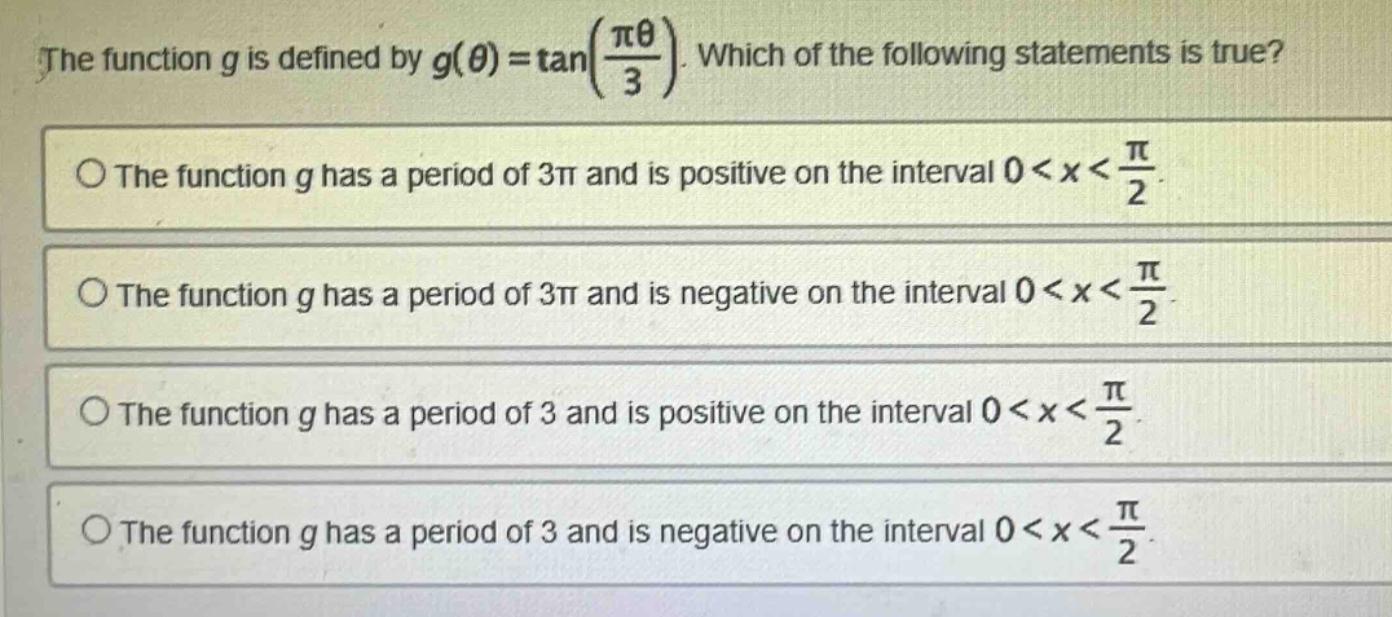
the function g is defined by g(θ)=tan(πθ/3). which of the following statements is true? the function g has a period of 3π and is positive on the interval 0<x<π/2. the function g has a period of 3π and is negative on the interval 0<x<π/2. the function g has a period of 3 and is positive on the interval 0<x<π/2. the function g has a period of 3 and is negative on the interval 0<x<π/2.
Answer
Explanation:
Step1: Recall period formula for tangent function
For $y = A\tan(Bx - C)+D$, the period $T=\frac{\pi}{|B|}$. In $g(\theta)=\tan(\frac{\pi\theta}{3})$, $B = \frac{\pi}{3}$, so $T=\frac{\pi}{\frac{\pi}{3}}=3$.
Step2: Analyze sign on interval
When $0 < x<\frac{\pi}{2}$, let $\theta=x$. Then $\frac{\pi\theta}{3}\in(0,\frac{\pi^{2}}{6})\approx(0,1.64)$. Since the tangent - function $y = \tan t$ is positive for $t\in(0,\frac{\pi}{2})$, and $\frac{\pi^{2}}{6}<\frac{\pi}{2}\approx1.57$, $\tan(\frac{\pi\theta}{3})>0$ for $0 <\theta<\frac{\pi}{2}$.
Answer:
The function $g$ has a period of 3 and is positive on the interval $0 < x<\frac{\pi}{2}$.