the function h is defined as h(θ) = tan θ. identify all inflection points on (π/2, 3π/2.\no π/2\no 3π/4\no…
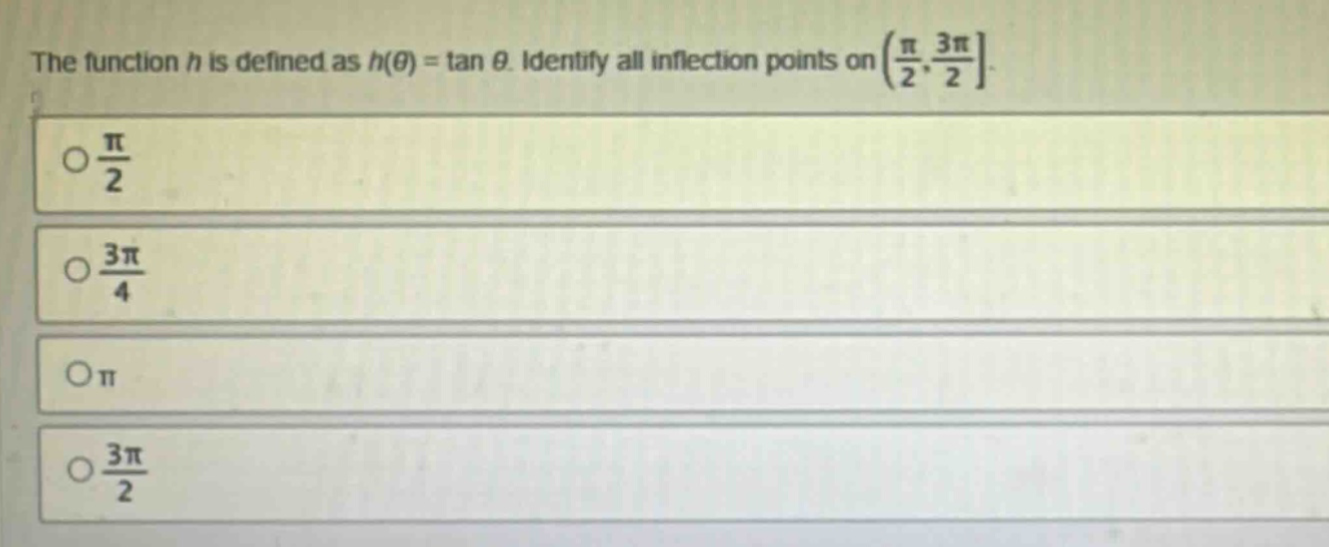
the function h is defined as h(θ) = tan θ. identify all inflection points on (π/2, 3π/2.\no π/2\no 3π/4\no π\no 3π/2
Answer
Answer:
C. $\pi$
Explanation:
Step1: Recall derivative of tangent
The first - derivative of $h(\theta)=\tan\theta$ is $h'(\theta)=\sec^{2}\theta$.
Step2: Find second - derivative
Using the chain - rule, if $y = \sec^{2}\theta=(\sec\theta)^{2}$, then $h''(\theta)=2\sec\theta\cdot\sec\theta\tan\theta = 2\sec^{2}\theta\tan\theta$.
Step3: Find where $h''(\theta) = 0$
Set $h''(\theta)=0$. Since $\sec^{2}\theta=\frac{1}{\cos^{2}\theta}\neq0$ for all real $\theta$ where $\cos\theta\neq0$, we solve $\tan\theta = 0$. In the interval $(\frac{\pi}{2},\frac{3\pi}{2})$, $\tan\theta = 0$ when $\theta=\pi$. So the inflection point in the given interval is $\theta=\pi$.