6. the function g has derivatives of all orders for all real numbers. the maclaurin series for g is given by…
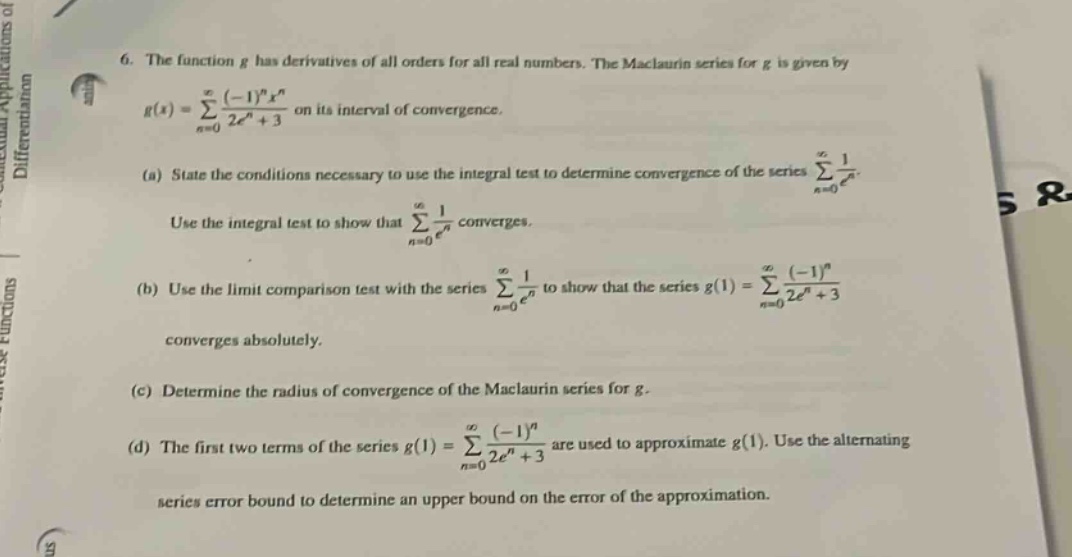
6. the function g has derivatives of all orders for all real numbers. the maclaurin series for g is given by g(x)=∑n = 0∞(−1)nxn2en+3 on its interval of convergence. (a) state the conditions necessary to use the integral test to determine convergence of the series ∑n = 0∞1en. use the integral test to show that ∑n = 0∞1en converges. (b) use the limit - comparison test with the series ∑n = 0∞1en to show that the series g(1)=∑n = 0∞(−1)n2en+3 converges absolutely. (c) determine the radius of convergence of the maclaurin series for g. (d) the first two terms of the series g(1)=∑n = 0∞(−1)n2en+3 are used to approximate g(1). use the alternating series error bound to determine an upper bound on the error of the approximation.
Answer
Answer:
(a)
Conditions for integral - test:
Let (a_n = f(n)), where (f(x)) is a continuous, positive, and decreasing function for (x\geq N) ((N) is a non - negative integer).
Proof of convergence of (\sum_{n = 0}^{\infty}\frac{1}{e^n}):
Let (f(x)=\frac{1}{e^x}=e^{-x}).
- Continuity: The function (y = e^{-x}) is continuous for all real (x).
- Positivity: For (x\geq0), (e^{-x}>0) since (e^x>0) for all real (x).
- Decreasing: Take the derivative (f^\prime(x)=-e^{-x}<0) for (x\geq0). Now, calculate the improper integral (\int_{0}^{\infty}e^{-x}dx=\lim_{t\rightarrow\infty}\int_{0}^{t}e^{-x}dx). [ \begin{align*} \lim_{t\rightarrow\infty}\int_{0}^{t}e^{-x}dx&=\lim_{t\rightarrow\infty}\left[-e^{-x}\right]{0}^{t}\ &=\lim{t\rightarrow\infty}\left(-e^{-t}+e^{0}\right)\ &= 1 \end{align*} ] Since the improper integral (\int_{0}^{\infty}e^{-x}dx) converges, by the integral test, (\sum_{n = 0}^{\infty}\frac{1}{e^n}) converges.
(b)
Let (a_n=\frac{1}{2e^n + 3}) and (b_n=\frac{1}{e^n}). Calculate the limit (\lim_{n\rightarrow\infty}\frac{a_n}{b_n}=\lim_{n\rightarrow\infty}\frac{\frac{1}{2e^n+3}}{\frac{1}{e^n}}=\lim_{n\rightarrow\infty}\frac{e^n}{2e^n + 3}). Divide numerator and denominator by (e^n): (\lim_{n\rightarrow\infty}\frac{e^n}{2e^n + 3}=\lim_{n\rightarrow\infty}\frac{1}{2+\frac{3}{e^n}}=\frac{1}{2}). Since (0<\lim_{n\rightarrow\infty}\frac{a_n}{b_n}=\frac{1}{2}<\infty) and (\sum_{n = 0}^{\infty}b_n=\sum_{n = 0}^{\infty}\frac{1}{e^n}) converges (from part (a)), by the limit - comparison test, (\sum_{n = 0}^{\infty}\left|\frac{(- 1)^n}{2e^n+3}\right|=\sum_{n = 0}^{\infty}\frac{1}{2e^n + 3}) converges. So, (g(1)=\sum_{n = 0}^{\infty}\frac{(-1)^n}{2e^n+3}) converges absolutely.
(c)
Use the ratio test. Let (a_n=\frac{(-1)^n x^n}{2e^n+3}). Then (a_{n + 1}=\frac{(-1)^{n+1}x^{n + 1}}{2e^{n+1}+3}). Calculate the ratio (\left|\frac{a_{n + 1}}{a_n}\right|=\left|\frac{\frac{(-1)^{n + 1}x^{n+1}}{2e^{n + 1}+3}}{\frac{(-1)^n x^n}{2e^n+3}}\right|=\left|x\right|\left|\frac{2e^n + 3}{2e^{n+1}+3}\right|). Divide numerator and denominator by (e^n): (\left|\frac{2e^n + 3}{2e^{n+1}+3}\right|=\left|\frac{2+\frac{3}{e^n}}{2e+\frac{3}{e^n}}\right|). Taking the limit as (n\rightarrow\infty), (\lim_{n\rightarrow\infty}\left|\frac{2+\frac{3}{e^n}}{2e+\frac{3}{e^n}}\right|=\frac{1}{e}). By the ratio test, the series converges when (\left|x\right|\frac{1}{e}<1), i.e., (\left|x\right|<e). So the radius of convergence (R = e).
(d)
The alternating series is (S=\sum_{n = 0}^{\infty}\frac{(-1)^n}{2e^n+3}), and the approximation uses the first two terms (S\approx\frac{(-1)^0}{2e^0+3}+\frac{(-1)^1}{2e^1+3}=\frac{1}{5}-\frac{1}{2e + 3}). For an alternating series (\sum_{n = 0}^{\infty}(-1)^n a_n) ((a_n>0), (a_{n+1}\leq a_n) and (\lim_{n\rightarrow\infty}a_n = 0)), the error bound (E_N\leq a_{N + 1}). Here (N = 1), (a_n=\frac{1}{2e^n+3}), so (a_2=\frac{1}{2e^2+3}).
Explanation:
(a)
Step1: State integral - test conditions
For (a_n = f(n)), (f(x)) must be continuous, positive, and decreasing.
Step2: Check conditions for (f(x)=e^{-x})
Show continuity, positivity, and decreasing nature.
Step3: Evaluate integral
(\lim_{t\rightarrow\infty}\int_{0}^{t}e^{-x}dx=\lim_{t\rightarrow\infty}\left[-e^{-x}\right]_{0}^{t}=1).
(b)
Step1: Define (a_n) and (b_n)
Let (a_n=\frac{1}{2e^n + 3}), (b_n=\frac{1}{e^n}).
Step2: Calculate limit
(\lim_{n\rightarrow\infty}\frac{a_n}{b_n}=\lim_{n\rightarrow\infty}\frac{e^n}{2e^n + 3}=\frac{1}{2}).
Step3: Apply limit - comparison test
Since (\sum b_n) converges and (0<\lim\frac{a_n}{b_n}<\infty), (\sum a_n) converges.
(c)
Step1: Apply ratio test
Find (\left|\frac{a_{n + 1}}{a_n}\right|=\left|x\right|\left|\frac{2e^n + 3}{2e^{n+1}+3}\right|).
Step2: Simplify ratio
Divide by (e^n) to get (\left|\frac{2+\frac{3}{e^n}}{2e+\frac{3}{e^n}}\right|).
Step3: Find limit
(\lim_{n\rightarrow\infty}\left|\frac{2+\frac{3}{e^n}}{2e+\frac{3}{e^n}}\right|=\frac{1}{e}), radius (R = e).
(d)
Step1: Identify alternating - series error formula
(E_N\leq a_{N + 1}) for (\sum_{n = 0}^{\infty}(-1)^n a_n).
Step2: Determine (a_2)
With (N = 1), (a_2=\frac{1}{2e^2+3}).