for each function, determine the long run behavior.\n(x^2 + 1)/(x^2 + 2) has select an answer\n(x^3 +…
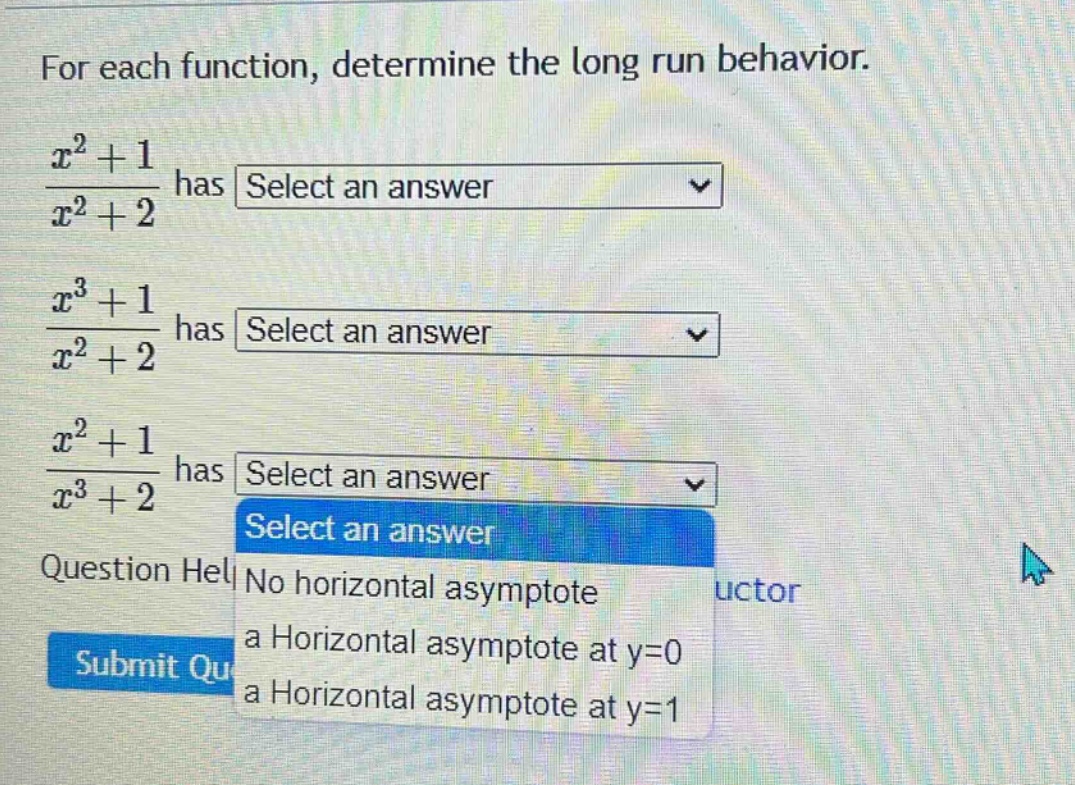
for each function, determine the long run behavior.\n(x^2 + 1)/(x^2 + 2) has select an answer\n(x^3 + 1)/(x^2 + 2) has select an answer\n(x^2 + 1)/(x^3 + 2) has select an answer\nquestion help no horizontal asymptote\nsubmit qu a horizontal asymptote at y=0\n a horizontal asymptote at y=1
Answer
Explanation:
Step1: Recall horizontal - asymptote rules
For a rational function $f(x)=\frac{a_nx^n+\cdots+a_0}{b_mx^m+\cdots + b_0}$, if $n = m$, the horizontal asymptote is $y=\frac{a_n}{b_m}$; if $n<m$, the horizontal asymptote is $y = 0$; if $n>m$, there is no horizontal asymptote.
Step2: Analyze $\frac{x^{2}+1}{x^{2}+2}$
Here $n = m=2$, $a_n = 1$, $b_m = 1$. So, $\lim_{x\rightarrow\pm\infty}\frac{x^{2}+1}{x^{2}+2}=\lim_{x\rightarrow\pm\infty}\frac{1+\frac{1}{x^{2}}}{1 + \frac{2}{x^{2}}}=1$. It has a horizontal asymptote at $y = 1$.
Step3: Analyze $\frac{x^{3}+1}{x^{2}+2}$
Here $n=3$, $m = 2$, $n>m$. So, $\lim_{x\rightarrow\pm\infty}\frac{x^{3}+1}{x^{2}+2}=\lim_{x\rightarrow\pm\infty}(x+\frac{1 - 2x}{x^{2}+2})=\pm\infty$. It has no horizontal asymptote.
Step4: Analyze $\frac{x^{2}+1}{x^{3}+2}$
Here $n = 2$, $m=3$, $n<m$. So, $\lim_{x\rightarrow\pm\infty}\frac{x^{2}+1}{x^{3}+2}=\lim_{x\rightarrow\pm\infty}\frac{\frac{1}{x}+\frac{1}{x^{3}}}{1+\frac{2}{x^{3}}}=0$. It has a horizontal asymptote at $y = 0$.
Answer:
- a Horizontal asymptote at y = 1
- No horizontal asymptote
- a Horizontal asymptote at y = 0