for the function, $h(x)=\frac{x^{2}-2x - 3}{x^{4}+4x^{3}+3x^{2}}$, which of the following is true?\n$h(x)$…
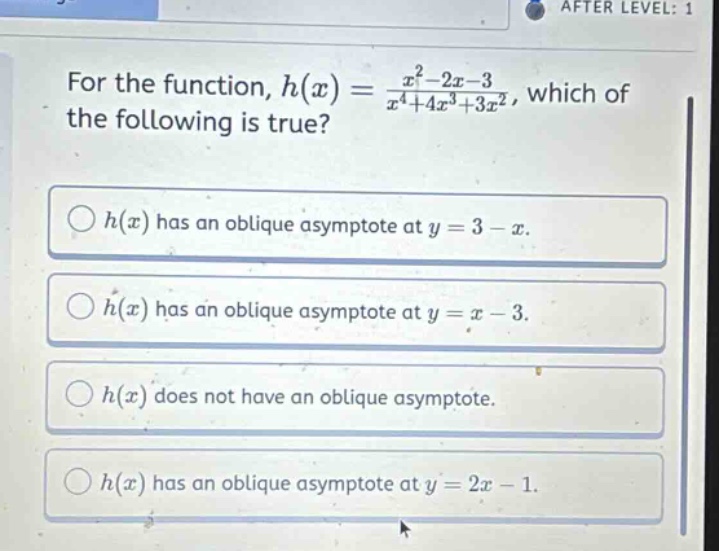
for the function, $h(x)=\frac{x^{2}-2x - 3}{x^{4}+4x^{3}+3x^{2}}$, which of the following is true?\n$h(x)$ has an oblique asymptote at $y = 3 - x$.\n$h(x)$ has an oblique asymptote at $y=x - 3$.\n$h(x)$ does not have an oblique asymptote.\n$h(x)$ has an oblique asymptote at $y = 2x-1$.
Answer
Answer:
C. $h(x)$ does not have an oblique asymptote.
Explanation:
Step1: Analyze degrees of polynomials
The degree of the numerator $n$ of $h(x)=\frac{x^{2}-2x - 3}{x^{4}+4x^{3}+3x^{2}}$ is $n = 2$ (highest - power of $x$ in $x^{2}-2x - 3$). The degree of the denominator $m$ is $m=4$ (highest - power of $x$ in $x^{4}+4x^{3}+3x^{2}$).
Step2: Recall oblique - asymptote condition
An oblique asymptote occurs when $m=n + 1$ for a rational function $\frac{f(x)}{g(x)}$ where $f(x)$ and $g(x)$ are polynomials. Here, $m=4$ and $n = 2$, and $m\neq n + 1$. So, $h(x)$ does not have an oblique asymptote.