the function (s(t)=-\frac{60}{49}t^{2}+\frac{120}{7}t) models the speed (s) (in miles per hour) of a car (t)…
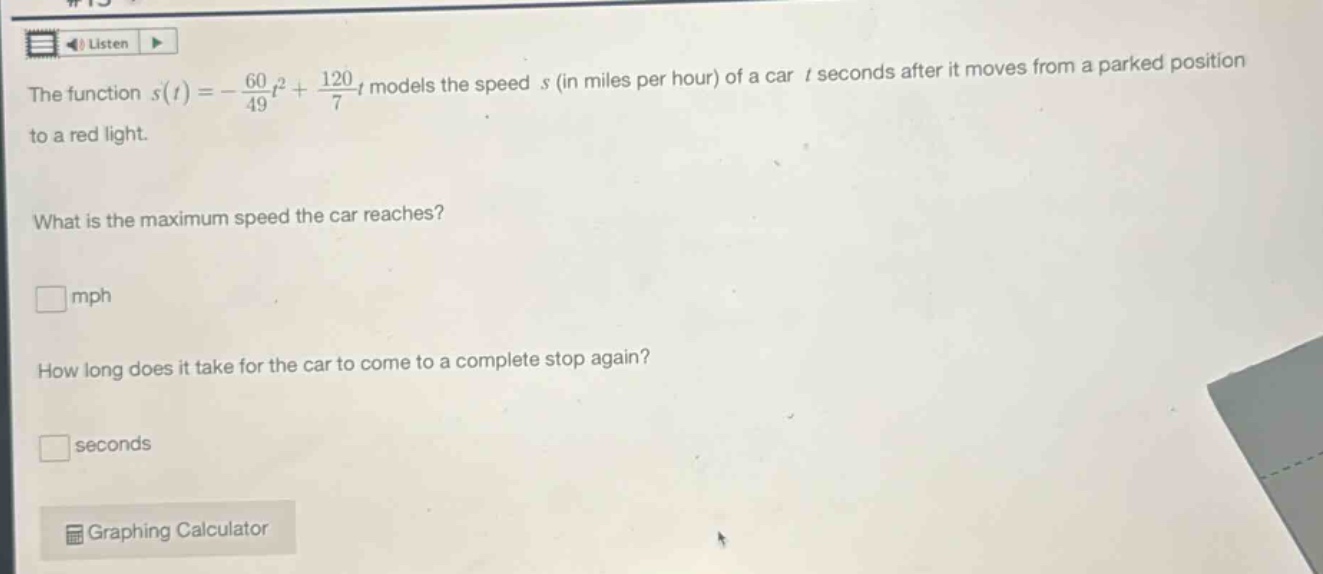
the function (s(t)=-\frac{60}{49}t^{2}+\frac{120}{7}t) models the speed (s) (in miles per hour) of a car (t) seconds after it moves from a parked position to a red light. what is the maximum speed the car reaches? mph how long does it take for the car to come to a complete stop again? seconds
Answer
Explanation:
Step1: Identify the function type
The speed - function $s(t)=-\frac{60}{49}t^{2}+\frac{120}{7}t$ is a quadratic function of the form $y = ax^{2}+bx + c$, where $a =-\frac{60}{49}$, $b=\frac{120}{7}$, and $c = 0$.
Step2: Find the time $t$ at which the maximum occurs
For a quadratic function $y=ax^{2}+bx + c$, the $x$ - coordinate of the vertex (which gives the time of maximum speed in our case) is $t=-\frac{b}{2a}$. Substitute $a =-\frac{60}{49}$ and $b=\frac{120}{7}$ into the formula: [ \begin{align*} t&=-\frac{\frac{120}{7}}{2\times(-\frac{60}{49})}\ &=-\frac{\frac{120}{7}}{-\frac{120}{49}}\ &=\frac{120}{7}\times\frac{49}{120}\ & = 7 \end{align*} ]
Step3: Find the maximum speed
Substitute $t = 7$ into the speed - function $s(t)$: [ \begin{align*} s(7)&=-\frac{60}{49}\times7^{2}+\frac{120}{7}\times7\ &=-\frac{60}{49}\times49 + 120\ &=- 60+120\ &=60 \end{align*} ]
Step4: Find the time when the car stops
The car stops when $s(t)=0$. So we set $s(t)=-\frac{60}{49}t^{2}+\frac{120}{7}t = 0$. Factor out $t$: $t(-\frac{60}{49}t+\frac{120}{7})=0$. We have two solutions: $t = 0$ (corresponds to the initial time when the car starts) and $-\frac{60}{49}t+\frac{120}{7}=0$. Solve $-\frac{60}{49}t+\frac{120}{7}=0$ for $t$: [ \begin{align*} -\frac{60}{49}t&=-\frac{120}{7}\ t&=-\frac{120}{7}\times(-\frac{49}{60})\ t&=14 \end{align*} ]
Answer:
The maximum speed the car reaches is 60 mph. It takes 14 seconds for the car to come to a complete stop again.