the function: y = \\frac{1}{x^{2}+1} over the interval -5,5 is revolved around the x - axis. find the…
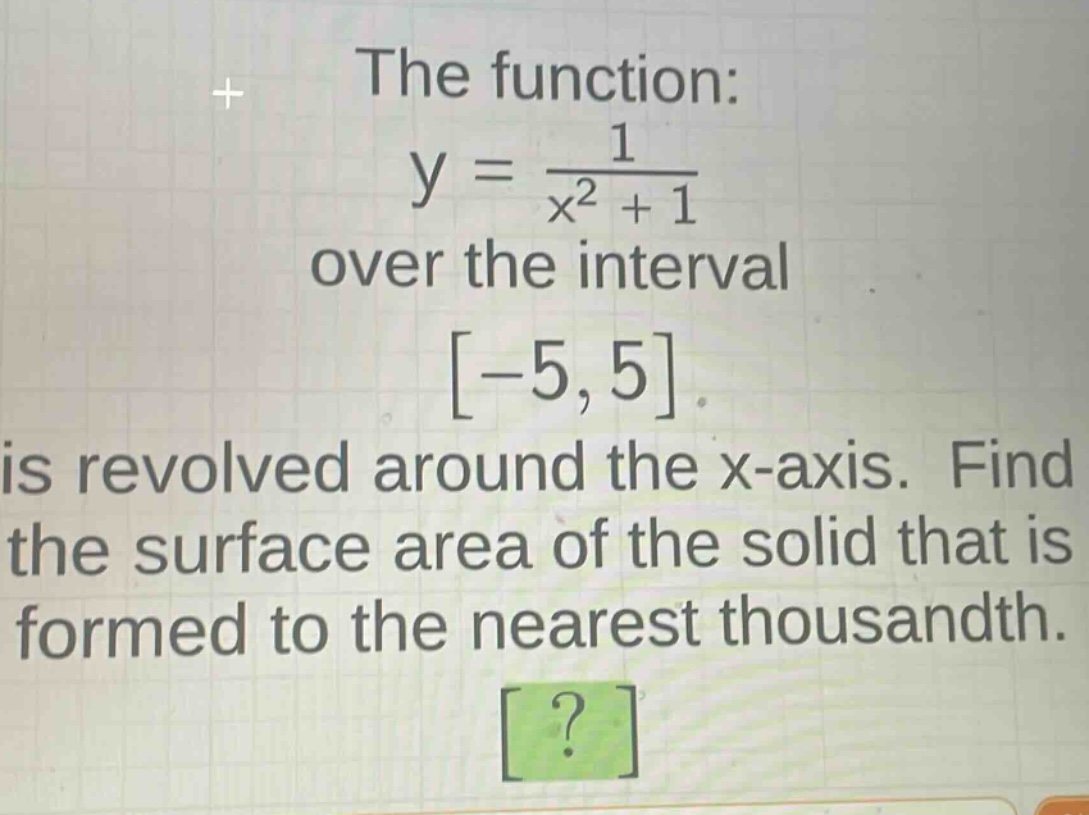
the function: y = \\frac{1}{x^{2}+1} over the interval -5,5 is revolved around the x - axis. find the surface area of the solid that is formed to the nearest thousandth.
Answer
Explanation:
Step1: Recall surface - area formula
The formula for the surface area (S) of a solid of revolution about the (x -)axis is (S = 2\pi\int_{a}^{b}y\sqrt{1+(y')^{2}}dx). First, find the derivative of (y=\frac{1}{x^{2}+1}=(x^{2}+1)^{-1}). Using the chain - rule, if (u = x^{2}+1), then (y = u^{-1}), and (y'=-1\times u^{-2}\times2x=-\frac{2x}{(x^{2}+1)^{2}}).
Step2: Calculate (1+(y')^{2})
[ \begin{align*} 1+(y')^{2}&=1+\frac{4x^{2}}{(x^{2}+1)^{4}}\ &=\frac{(x^{2}+1)^{4}+4x^{2}}{(x^{2}+1)^{4}} \end{align*} ]
Step3: Set up the integral
The surface - area integral is (S = 2\pi\int_{-5}^{5}\frac{1}{x^{2}+1}\sqrt{\frac{(x^{2}+1)^{4}+4x^{2}}{(x^{2}+1)^{4}}}dx=2\pi\int_{-5}^{5}\frac{\sqrt{(x^{2}+1)^{4}+4x^{2}}}{(x^{2}+1)^{3}}dx). Since the integrand is an even function (i.e., (f(-x)=f(x))), we can rewrite the integral as (S = 4\pi\int_{0}^{5}\frac{\sqrt{(x^{2}+1)^{4}+4x^{2}}}{(x^{2}+1)^{3}}dx).
Step4: Use numerical integration
This integral is difficult to solve analytically. We can use a numerical method such as the trapezoidal rule or a calculator with numerical integration capabilities (e.g., a TI - 84 Plus: fnInt(4*pi*sqrt((X^2 + 1)^4+4*X^2)/((X^2 + 1)^3),X,0,5)).
Using a calculator for numerical integration, we find that (S\approx 11.729).
Answer:
(11.729)