a function, f, is given.\n\nf(x)=x² + 12x + 20\n\nselect terms to describe the end behavior of the…
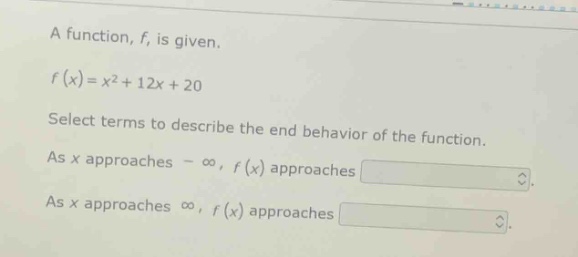
a function, f, is given.\n\nf(x)=x² + 12x + 20\n\nselect terms to describe the end behavior of the function.\n\nas x approaches -∞, f(x) approaches\n\nas x approaches ∞, f(x) approaches
Answer
Explanation:
Step1: Analyze the leading term
The function (f(x)=x^{2}+12x + 20) is a quadratic function. The leading term is (x^{2}), and its coefficient (a = 1>0).
Step2: Determine the end - behavior
For a quadratic function (y = ax^{2}+bx + c) ((a\neq0)), when (a>0):
- As (x\to-\infty), (y = ax^{2}+bx + c\approx ax^{2}). Since (a = 1>0) and (x^{2}>0) for all (x\neq0), when (x\to-\infty), (x^{2}\to+\infty) and (f(x)=x^{2}+12x + 20\to+\infty).
- As (x\to+\infty), (y = ax^{2}+bx + c\approx ax^{2}). Since (a = 1>0) and (x^{2}>0) for all (x\neq0), when (x\to+\infty), (x^{2}\to+\infty) and (f(x)=x^{2}+12x + 20\to+\infty).
Answer:
As (x) approaches (-\infty), (f(x)) approaches (+\infty). As (x) approaches (+\infty), (f(x)) approaches (+\infty).