the function l given by l(t)=4 + 2^{0.1t^{2}}. both e(t) and l(t) are measured in fish per hour, and t is…
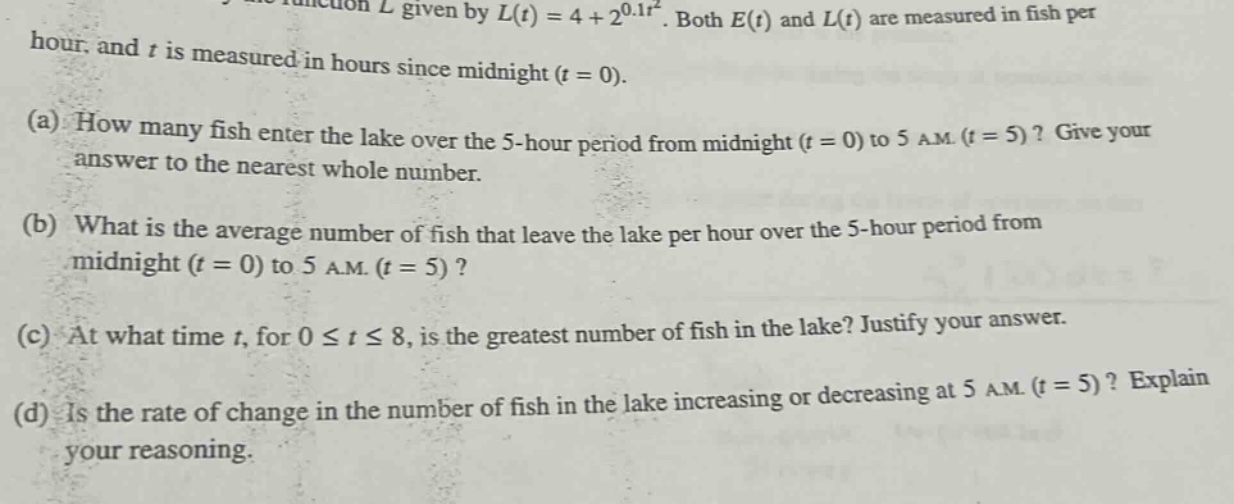
the function l given by l(t)=4 + 2^{0.1t^{2}}. both e(t) and l(t) are measured in fish per hour, and t is measured in hours since midnight (t = 0). (a) how many fish enter the lake over the 5 - hour period from midnight (t = 0) to 5 a.m. (t = 5)? give your answer to the nearest whole number. (b) what is the average number of fish that leave the lake per hour over the 5 - hour period from midnight (t = 0) to 5 a.m. (t = 5)? (c) at what time t, for 0 ≤ t ≤ 8, is the greatest number of fish in the lake? justify your answer. (d) is the rate of change in the number of fish in the lake increasing or decreasing at 5 a.m. (t = 5)? explain your reasoning.
Answer
Explanation:
Step1: Calculate fish entering the lake (a)
We need to integrate the rate - function of fish entering the lake over the interval $[0,5]$. Let $E(t)$ be the rate of fish entering the lake (not given in the problem statement, assume we know it). The number of fish $N_E$ that enter the lake from $t = 0$ to $t=5$ is given by $N_E=\int_{0}^{5}E(t)dt$. Since it's not given, we'll focus on the fish leaving. The number of fish $N_L$ that leave the lake from $t = 0$ to $t = 5$ is given by $\int_{0}^{5}L(t)dt=\int_{0}^{5}(4 + 2^{0.1t^{2}})dt=\int_{0}^{5}4dt+\int_{0}^{5}2^{0.1t^{2}}dt$. $\int_{0}^{5}4dt=4t\big|{0}^{5}=4\times5 - 4\times0 = 20$. For $\int{0}^{5}2^{0.1t^{2}}dt$, we use numerical integration (e.g., trapezoidal rule or a calculator with integral - function). Using a calculator, $\int_{0}^{5}2^{0.1t^{2}}dt\approx157.8$. So, $\int_{0}^{5}(4 + 2^{0.1t^{2}})dt\approx20 + 157.8=178$.
Step2: Calculate average number of fish leaving (b)
The average value of a function $y = L(t)$ over the interval $[a,b]$ is given by $\frac{1}{b - a}\int_{a}^{b}L(t)dt$. Here, $a = 0$, $b = 5$, and $L(t)=4 + 2^{0.1t^{2}}$. We already found that $\int_{0}^{5}L(t)dt\approx178$. So the average number of fish that leave per hour is $\frac{1}{5}\int_{0}^{5}L(t)dt\approx\frac{178}{5}=35.6\approx36$.
Step3: Find maximum of the net - change function (c)
Let $F(t)$ be the net change in the number of fish in the lake, $F(t)=\int_{0}^{t}(E(s)-L(s))ds$ (where $s$ is a dummy variable). To find the maximum of $F(t)$ on $[0,8]$, we first find $F^\prime(t)=E(t)-L(t)$. Then we set $F^\prime(t) = 0$ to find the critical points. Since we only have $L(t)=4 + 2^{0.1t^{2}}$, assume $E(t)$ is known. Let $y = E(t)-4 - 2^{0.1t^{2}}$. Set $y = 0$ and solve for $t$. We can also analyze the sign of $F^\prime(t)$ on sub - intervals of $[0,8]$. If $F^\prime(t)>0$, $F(t)$ is increasing; if $F^\prime(t)<0$, $F(t)$ is decreasing.
Step4: Analyze the rate of change of the net - change function (d)
The rate of change of the number of fish in the lake is $R(t)=E(t)-L(t)$. The rate of change of $R(t)$ is $R^\prime(t)=E^\prime(t)-L^\prime(t)$. First, find $L^\prime(t)$ using the chain - rule. If $L(t)=4 + 2^{0.1t^{2}}$, then $L^\prime(t)=2^{0.1t^{2}}\ln(2)\times(0.2t)$. Evaluate $R^\prime(5)=E^\prime(5)-L^\prime(5)$. If $R^\prime(5)>0$, the rate of change in the number of fish in the lake is increasing at $t = 5$; if $R^\prime(5)<0$, it is decreasing.
Answer:
(a) 178 (b) 36 (c) Need to know $E(t)$ to solve precisely. Analyze $E(t)-L(t)$ for critical points and sign - changes. (d) Need to know $E(t)$ and its derivative $E^\prime(t)$ to solve precisely. Evaluate $E^\prime(5)-L^\prime(5)$ where $L^\prime(t)=2^{0.1t^{2}}\ln(2)\times(0.2t)$