the function f is given by f(x)=0.1x^4 - 0.5x^3 - 3.3x^2 + 7.7x - 1.99. for how many positive values of b…
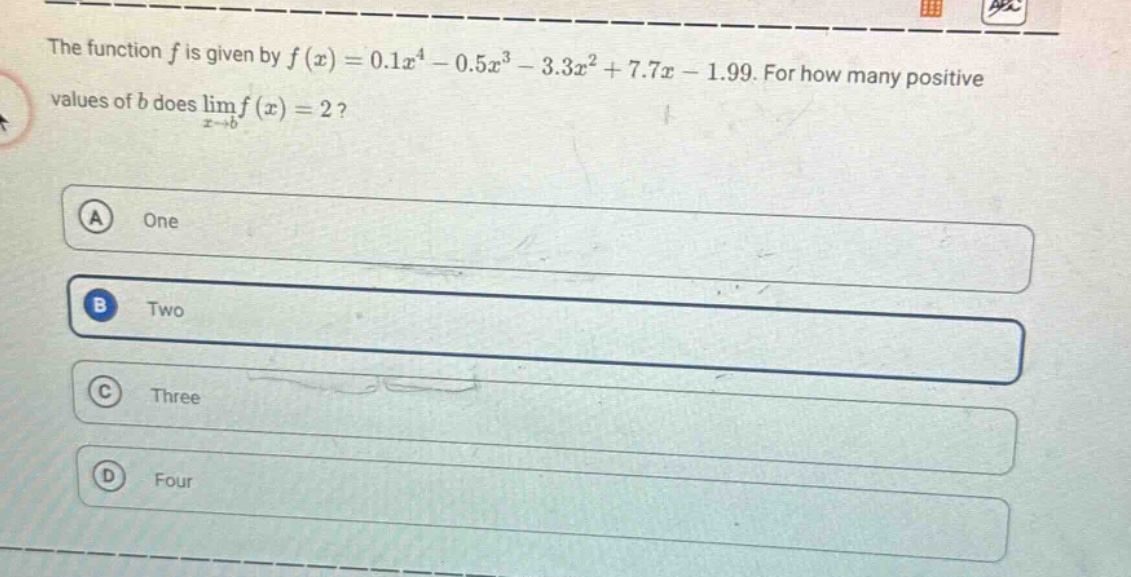
the function f is given by f(x)=0.1x^4 - 0.5x^3 - 3.3x^2 + 7.7x - 1.99. for how many positive values of b does lim(x→b)f(x)=2? a one b two c three d four
Answer
Explanation:
Step1: Set up the equation
We know that if $\lim_{x\rightarrow b}f(x) = 2$, then $f(b)=2$ since $f(x)=0.1x^{4}-0.5x^{3}-3.3x^{2}+7.7x - 1.99$ is a polynomial function. So we set up the equation $0.1b^{4}-0.5b^{3}-3.3b^{2}+7.7b-1.99 = 2$, which simplifies to $0.1b^{4}-0.5b^{3}-3.3b^{2}+7.7b - 3.99=0$.
Step2: Analyze the polynomial
Let $g(b)=0.1b^{4}-0.5b^{3}-3.3b^{2}+7.7b - 3.99$. We can use a graph - ing utility or the Intermediate Value Theorem. A fourth - degree polynomial $y = ax^{4}+bx^{3}+cx^{2}+dx + e$ ($a = 0.1>0$) has the general shape of a "W" or an "M". By graphing $y = g(b)$ (either using a graphing calculator or software like Desmos), we can find the number of positive roots of the polynomial. When we graph the function $y = 0.1x^{4}-0.5x^{3}-3.3x^{2}+7.7x - 3.99$, we can see that it intersects the $x$ - axis at two positive $x$ values.
Answer:
B. Two