the function f is given by f(θ)=2cos²θ + 3sinθ - 3. for what values of θ on 0 ≤ θ ≤ 2π does f(θ)=0? a 0 and…
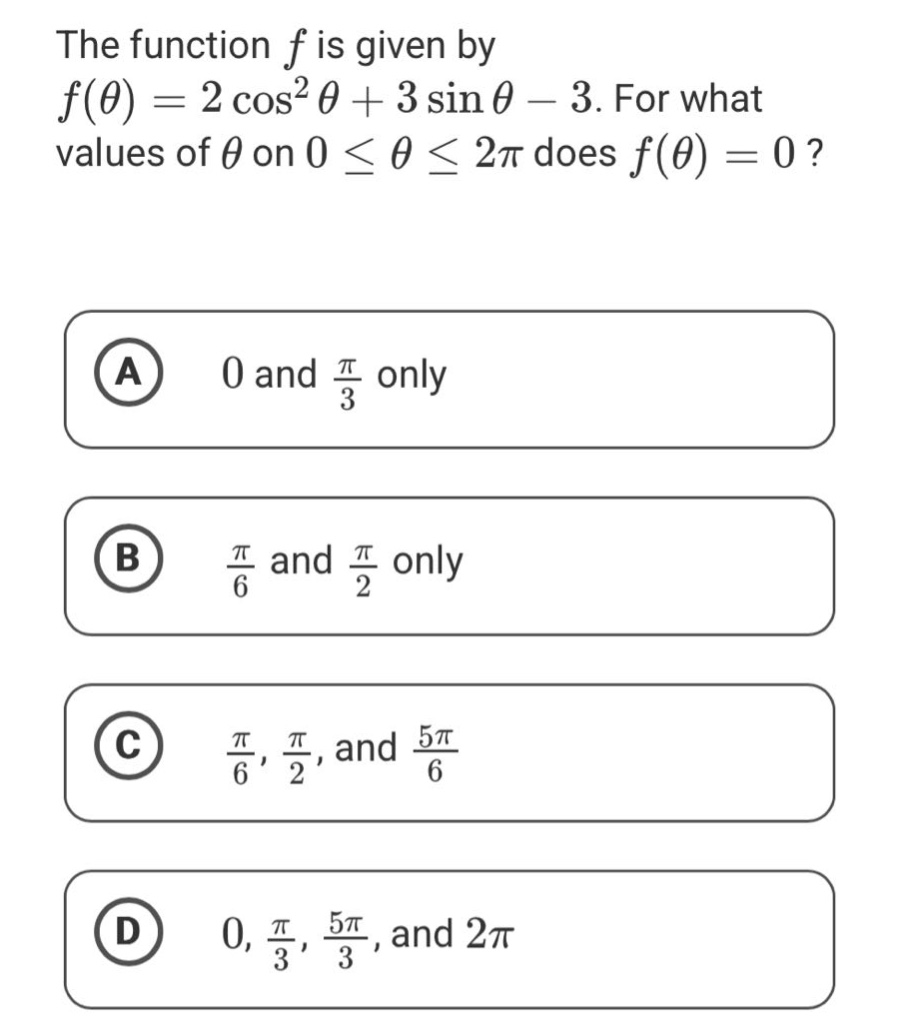
the function f is given by f(θ)=2cos²θ + 3sinθ - 3. for what values of θ on 0 ≤ θ ≤ 2π does f(θ)=0? a 0 and π/3 only b π/6 and π/2 only c π/6, π/2, and 5π/6 d 0, π/3, 5π/3, and 2π
Answer
Explanation:
Step1: Use the identity $\cos^{2}\theta=1 - \sin^{2}\theta$
Substitute $\cos^{2}\theta$ in $f(\theta)$: $f(\theta)=2(1 - \sin^{2}\theta)+3\sin\theta - 3$. Expand to get $f(\theta)=2-2\sin^{2}\theta + 3\sin\theta - 3=-2\sin^{2}\theta+3\sin\theta - 1$.
Step2: Let $x = \sin\theta$
The equation $f(\theta)=0$ becomes $-2x^{2}+3x - 1 = 0$. Multiply through by - 1 to get $2x^{2}-3x + 1=0$.
Step3: Factor the quadratic equation
Factor $2x^{2}-3x + 1$ as $(2x - 1)(x - 1)=0$.
Step4: Solve for $x$
Set each factor equal to zero: If $2x - 1=0$, then $x=\frac{1}{2}$; if $x - 1=0$, then $x = 1$.
Step5: Substitute back $\sin\theta$ for $x$
When $\sin\theta=\frac{1}{2}$, $\theta=\frac{\pi}{6}$ or $\theta=\frac{5\pi}{6}$ (since $\sin\theta$ has a value of $\frac{1}{2}$ in the first and second quadrants for $0\leq\theta\leq2\pi$). When $\sin\theta = 1$, $\theta=\frac{\pi}{2}$.
Answer:
C. $\frac{\pi}{6},\frac{\pi}{2}$, and $\frac{5\pi}{6}$